Tag: Videography

  • Blog: My Versatile Pocket Camera

    You know what it’s like right: you are out on a location, and something unexpected happens. Not the bad kind of unexpected – but the good kind. The kind of thing that you wish you had your camera for, all prepped and ready to roll. A versatile pocket camera would be sweet right now, right?

    The fact of the matter is that unless you are on a professional shoot, that simply might not be the case. But imagine if you could load a camera with fully functioning professional settings, in less than 20 seconds. I would at least consider killing for that kind of functionality. The good news is that I never need to.

    I rock around town with a humble Samsung Galaxy S6 in my pocket all the time. In a real bind, this at least gives me the 2-second capacity to take a rough record of what is going down. But then two years ago I discovered an app that many iPhoneographers would be very well acquainted with: FILMiC Pro.

    I love this app. You pretty much have the full manual controls that you would expect from your DSLR or mirrorless cameras – but it is in your phone! Want to take control of the aperture and white balance? That’s not going to be a problem. Feel like exploring the range of focus? Are you kidding? Get in there and set up a fully-fledged rack-pull! Not only that: you can then save all of your settings into a series of presets: imagine being able to run from inside under fluorescent lights, to outside in the bright sun – and handle the transition in next to no time on the same device.

    Seriously … squeezing what professionals do into a workable phone app, FILMiC Pro gives you arguably one of the best video accessories out there. Not convinced? Well, director Sean Baker took an iPhone, used the FILMiC Pro app (with some other cinematic sweetness, it must be said), and shot a short film. In fact, it went on to be theatrically released at Sundance. How sweet is that?!

    Photographer Chase Jarvis famously said that, “The best camera is the one that’s with you.” More than anything else, that is why I have loved having my S6. Constantly in my pocket, I can grab it, double-tap on the home button, and load the in-built camera in just seconds. Should there be a few extra seconds to play with though – then I launch into the FILMiC Pro app, take full control of my settings, and am prepared to make the magic happen.

    This is in no-way a paid advertisement for the guys… I just really love what it brings to the mobile cinematography marketplace. So, if you are interested in taking your phoneography to a new cinematic level – then do yourself a HUGE favour, and get the app today. At worst, it will be the first step in revolutionising your phones camera video quality. At best – it will mean having professional flexibility always on hand, sitting in your pocket. And you will be ready for that unexpected.
  • Blog: Employing Symmetry (Part 2)

    Blog: Employing Symmetry (Part 2)

    In part 1, we introduced the idea of engaging with symmetry. The reason for this guide? In the same way that we tend to love patterns, symmetry is like Nutella for our eyes. And if you don’t like Nutella, what’s wrong with you? Seriously… Nutella is great. And peanut butter. Yum. Nutella AND and peanut butter. Om nom nom.

    Anyhoo, I digress.

    Why do we like symmetry so much? No one actually knows. There have been studies that reveal that babies will stare longer at symmetrical pictures than they will at asymmetrical ones. And scientific evidence also suggests that as a species we’re more attracted to symmetrical faces. In short, there is something extremely appealing about symmetry, and we’re drawn to it. So, then, we need to have a really, really good reason to intentionally mess with this particular guide.

    As with most of the visual rules we employ – that is the key. Once we understand how and why it works – and just as importantly, we can make it work ourselves – we can then consider messing with it. Take for example Stanley Kubrick, as he is a great case study for a/symmetrical cinematography:

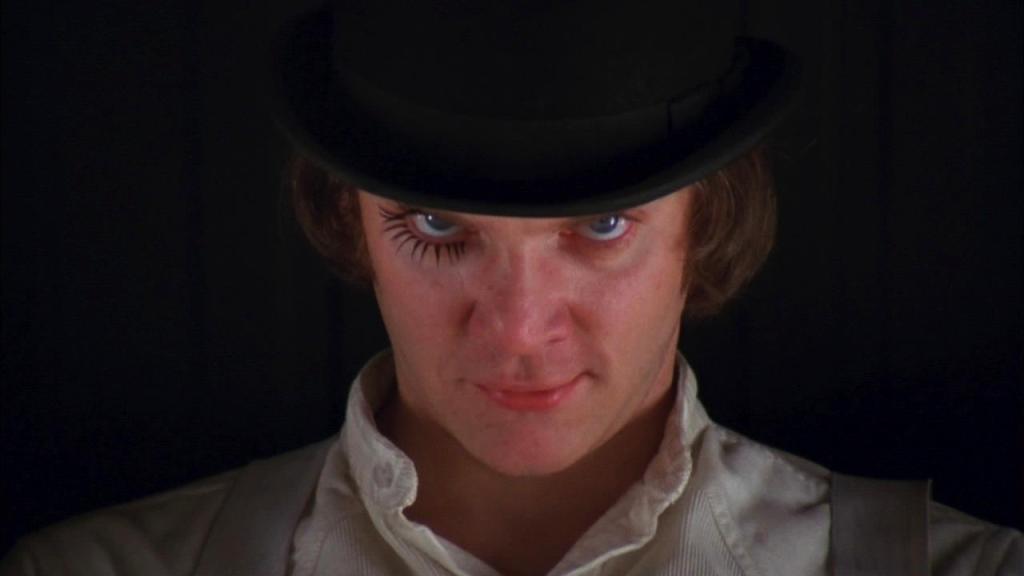
    In cinema what isn’t shown is almost as important as what is. Take the masterful direction of A Clockwork Orange’s opening scene for example.

    Kubrik could have started with a wide shot of the Korova Milk Bar. Instead, he begins with a 16-second straight-on tight shot of Alex’s (the protagonist) face in centre frame. Why? In an instant, he highlights a contrast between symmetry and asymmetry to describe Alex’s madness and deviant behaviour.

    Without uttering a word, the viewer immediately perceives the symmetry. But as the 16-seconds lingers, a visual disquiet makes itself known. In addition to being stared at, there was an alteration to the natural balance: Alex has placed black eyelashes on his right eye only. It is only a tiny detail – and yet it is enough for most viewers to be disturbed by this variation, hinting to them that Alex is not normal. This is then emphasised as the long take begins it’s zoom out.

    Let me say this – and I really can’t stress this enough – there should be no rules when it comes to cinema. Techniques such as symmetrical framing (amongst all the rest) will almost ensure that your image will be aesthetically pleasing. But we do run the risk of creating images that are predictable, common, and quite frankly, boring. Nevertheless – we need to know them, know why they work, know how they work, and know why our piece needs to throw that guide right out the window. Even if it’s by using something as simple as eyelashes.

    Do you have your own thoughts and symmetrical suggestions? Leave a comment below. And if you would like to check out another blog post looking at symmetry, the you can gorge yourself right here.

  • Blog: Employing Symmetry (Part 1)

    If you have ever done research on how to get the right visual shot – whether painted, photographed, or captured in motion – then you probably know the ‘rules.’ This stuff isn’t new. But today I think it’s worth repeating.

    The elephant in the room is that, to misquote the rogue pirate Barbossa, “… the code is more what you’d call “guidelines” than actual rules.” While there is aesthetic appeal with a host of the visual rules that have developed over centuries – the fact is that we can quite easily go ahead and break them. But. Before we do… we really ought to know why the guidelines exist, and why they work first. Then we can decide when and how to best ignore them for our work.

    To demonstrate, take a look at this montage of the cinematographic symmetry (try saying that three times fast!) used in the internationally acclaimed TV series, Sherlock.

    There is something kind of soothing about it, isn’t there? To put it as simply as I can, where the goal of composition is to create a path that is pleasing for the eyes to follow (this is why the guideline exists) – symmetry gives the viewer a vague sense of the harmonious, of beautiful proportions, and of balance (this is why this particular guideline works).

    There are many techniques that will strengthen (or weaken) the symmetric properties of an object or scene. How much of a scene we choose to show is paramount. So too is the position of the camera in relation to the subject, its height, tilt etc. We also need to take particular care to ensure the centre of the composition is equidistant (my word of the day!) to both sides. When done right, it looks simply beautiful. But can you imagine – for example – a shot of the Taj Mahal (an entirely symmetrical structure… right down to its symmetrical reflection in the pools of water around it) that has been misaligned? Well… it would look sort of like this…

    The fact that this image is only slightly out is enough to make it a jarring visual. So while it is possible to break the guidelines of symmetry, if and when we chose to do so, we will really need to go all out. No half measures.

    Coming up in part 2, we will finish looking at how to employ symmetry with another example or two, and some concluding considerations.

  • Tech News: The GH5… The New Face of Change?

    Tech News: The GH5… The New Face of Change?

    Canon and Nikon have been the big boys in the consumer and semi-pro market for like, ever. Most people will kind of remember the moment when Canon released their game-changing Canon EOS 5D Mk II. Though apparently an afterthought by Canon – I don’t think that this is an overstatement: the video capabilities of the updated 5D shifted everything in the world of videography. Ev.’ry.thing.

    That was in 2008 though. 4K video becoming something of an expectation in 2016. So, with the release of the 5D Mk IV earlier this year, Canon (despite the MkII and III being mainstays in many a videographers kit) still seemed to be taking the whole DSLR video thing as an afterthought. Though cynical, perhaps it was to be expected. After all, Canon already has  an extensive cinema and large sensor product line dedicated towards meeting the needs of pro-video and cinema users, right?

    The thing is that while Canon has slept at the wheel since accidentally reinventing how we make videos, tech has continued to move on, advancements have continued, and new players have captured hearts and minds. The current king of the hill would have to be Sony, wooing videographers of all persuasions with the a7S and a7S II. But the proverbial apple cart looks set to be shaken once again, with Panasonic announcing the release of the GH5 in  2017.

    The GH4 has been almost as popular as the Sony a7S – but there are a few little tricks that the latest model is bringing to the game that will arguably push them into first place in the race for mirrorless camera supremacy. For example, you will be able to shoot 10-bit, 60fps 4K footage. Yes!

    We all need to watch this space as full specs and reviews begin to come in. Until then, perhaps you will let Panasonic begin wooing you with this heartwarming prologue.

  • HIMM: How to Get Smooth Footage

    How It’s Made Monday is meant to inspire you with some of the secrets of videocraft: and today, we’re sharing a great little tip on how to get smooth footage. In short – by yourself a gimbal!

    The 3-axis gimbal market has been exploding all over the place for the last little while: and there have been some pretty cool advances since the first generation of commercially available gimbals hit the market. Little things like going from a 10-bit system to a 32-bit system. And then there is fun bits of kit like this to contend with: the CAME-TV Single!

    https://vimeo.com/146584738

    For under US$1K, you can now get a pretty sweet hand-held motorised 3-axis gimbal… with encoders! In geek speak, encoders are often used in robotics for highly accurate monitoring of motor position. Some of the benefits of using encoders include: preventing motors from losing synchronization and skipping steps, providing important information about frame and camera angles, decreasing power consumption (this is my biggest plus – longer battery life!!), increasing torque, increasing precision of stabilization, and more.

    So check out the review by Tom Antos (which includes some visuals he shot using the Came Single), and be inspired… super smooth professional looking footage is well within reach of the average videographer!

  • WW: Why You Need to Understand Colour Temperature

    WW: Why You Need to Understand Colour Temperature

    Welcome to Whatsit Wednesday – a series that will resource you to do video better, offering hints and tips on how to improve your videocraft. Today, we’re sharing a short article on why we need to understand colour temperature.

    Is understanding colour temperature and balance in an increasingly web-based ‘phoneography‘ (think cinematography for phones) marketplace really that important? The answer is simple: yes.

    Understanding colour temperature will improve the quality of your work and give you an advantage over your competitors – those average Joe’s who either don’t know any better, or frankly don’t care. In short, this is the kind of stuff that separates the amateurs from the professionals – and even if you ARE an amateur, the equation is simple: when you know more about what you’re doing, you will begin to produce visuals that look more professional.

    Covering a range of issues such as camera white balance and RAW, as well as examining some of the physics of colour, Richard Lackey has once again delivered an excellent article that will help you understand colour temperature, so that “you will always be ready to balance your camera even in situations where you have no control over lighting at all.”

    Article.

  • WW: How To 3-Point Light An Interview On A Low Budget

    WW: How To 3-Point Light An Interview On A Low Budget

    Welcome to Whatsit Wednesday – a series that will resource you to do video better, offering hints and tips on how to improve your videocraft. Today, we’re sharing a short video tutorial on how you can successfully light an interview when on a low budget.

    When it comes to storytelling from the heart, Stillmotion believe you can learn more from a well-informed friend than you can from the finest academic institutions. To that end, that is how they approach everything they teach–as colleagues. This is also why we are sharing this great tutorial: though originally posted three years ago (and originally titled How to Light An Interview for $26), the presentation is great and the lighting-hack they suggest is still super usable!

  • FF: Quentin Tarantino’s Best Visual Film References… in 3 Minutes!

    FF: Quentin Tarantino’s Best Visual Film References… in 3 Minutes!

    Welcome to the very first Flick Friday post for 2016 – a series that will motivate you, supercharging your creativity as we delve into cinematography and videography together. Today, we’re sharing a great video montage by Jacob T. Swinney on Quentin Tarantino’s Visual References.

    There is lots to be said about this great montage, but we will leave it to Swinney himself to entice you: “It is a well known fact that Quentin Tarantino is a self-proclaimed cinephile. But the writer/director’s love for cinema is most obviously expressed through his own films. In addition to showing his characters spending a great deal of time discussing cinema, Tarantino’s films are jam-packed with homages and visual references to the movies that have intrigued him throughout his life.

    Many filmmakers pay homage, but Tarantino takes things a step further by replicating exact moments from a variety of genres and smashing them together to create his own distinct vision.”

    With over 30 of these visual references to be had, in a word – it is simply brilliant.

    https://vimeo.com/148955244

  • WW: 3 Ways to Approach Day to Night Timelapse

    WW: 3 Ways to Approach Day to Night Timelapse

    Welcome to the very first Whatsit Wednesday post for 2016 – a series that will resource you to do video better, offering hints and tips on how to improve your videocraft. Today, we’re sharing a 50-minute tutorial on 3 ways that you can go about approaching a day to night timelapse through manipulating aperture priority, blending in post, and ramping up your exposure/ISO.

    Made by Saskatchewan (Canada) local, Preston Kanak – this filmmaker, educator, and time-lapse photographer, unpacks the time-lapse ‘holy grail.’ Demonstrating that while there is an assumption that the day-to-night lapse is complex, the reality is that they may not be as difficult for you to achieve as they appear.

  • HIMM: 4 Things to Help Get A Cinematic Look on a Budget

    HIMM: 4 Things to Help Get A Cinematic Look on a Budget

    One of the most common questions young filmmakers ask is, “How do I make my film look cinematic?” Usually the answer is “good lighting” – but what if you don’t have access to any?

    Though still in school, it is exciting to hear ideas from host and creator of DSLRguide – Simon Cade. Why? Well, when creating content on a tiny budget, you are forced to consider how to make cinematic visuals a little differently: so when a young guy who spends most of his time filming, editing, or learning about filmmaking takes the time to share some of his experiences on how he has gone about achieving that – it’s something worthwhile considering.

    Cade identifies the following four things as items that will help you make up for bad, or at least less than special lighting: locations and sets, colour, emotion, and senses. It’s by no means a comprehensive list – but it will certainly inspire you to move in the right direction.

    “I’m all about learning the meaning behind the choices we make in films, and using film as a method of communication.” – Simon Cade.