One of the things that I enjoy about film and television is seeing how different directors and DP’s style their work. Even if we have never consciously considered the styling used – once it has been pointed out, we will generally have an “oh yeah!” moment. This phenomena is precisely why I enjoy the following clip by Spanish editor Jorge Luengo Ruiz.
Inspired by an interview with DP Michael Slovis of AMC’sBreaking Bad fame, Luengo Ruiz highlights a key stylistic shot used throughout the show by montaging them all together into a short 4-minute piece. Care to guess what it is before clicking play?
Ever wondered what might happen if you attached a really old-school lens onto your mirrorless camera? I have. Fun fact, Mathieu Stern (Mathieustern Production) has wondered about this too.
Releasing the first part of his new web-series on Monday, Stern – a French web video producer and photographer based in Paris – is focusing solely on what kind of “weird” lenses can be mounted on a mirrorless digital camera. The premise is simple and elegant: what visuals can come of such mismatched pairings?
In this first clip, Stern tests a 1910 folding camera lens on a Sony A7II: going through several steps, an Eastman Kodak Kodex / Topaz Boyer Paris f6.3 120mm is finally let loose upon the digital landscape! If you’re familiar with the properties of old lenses, you probably won’t be too surprised by the look of the final footage. Nevertheless, I still find the finished result nostalgically pleasing.
Australian Director George Miller decided that he did not wish to do a remake or retell the Mad Max story – rather, he wanted to update the universe and the wasteland. He even asked his wife Margaret Sixel to edit the film, even though she had never edited action before. his logic was that, “… if a guy did it, it would look like every other action movie.”
Even though 2015’s Mad Max: Fury Road is technically an independent movie in the series, it was always a matter of time before someone put in the effort to see whether there were visual echoes between the original Australian New Wave trilogy (1979, 1981, and 1985) and the 2015 release. The good news for fans of the original series is that despite 30-years between drinks, as well as all his intentions to give the world something fresh in Fury Road, a Miller film is a Miller film – and there are echoes in abundance. I hope you enjoy the comparisons as much as I did.
So this last week I enjoyed some time off to visit a couple of friends who happen to be Air B’n’B‘ing in Dieppe in the north of France: and that gave me an idea for my first post back… are there any nicely composed videos out there that show off Dieppe? Thank the heavens for Vimeo, because there is! So please enjoy this scenic journey through my holiday… taken by someone else… from a vantage point I didn’t get to personally check out… a few years ago… 🙂
Don’t worry, there are no spoilers here. Well, not unless you haven’t watched any of The Walking Dead over the last five years perhaps. Other than that, you ought to be golden with this post.
I have done a wide variety of media work over the years: this often means needing to up-skill. When I first tried my hand at After Effects, the free training that the team at Creative Cow offered was there to guide me through a very steep learning curve. Fast forward to right now, and I usually just check out the highlights off the latest e-newsletter. Well today I couldn’t help but notice that there were linking to a fantastic interview that they did with David Boyd back in 2012.
Be warned, it is a little TLDR (yeah, not a video interview… it’s that old school type of article!)… but Boyd has since gone on to DP on shows like Agents of S.H.I.E.L.D., as well as directing episodes of Sleepy Hollow, Once Upon a Time, 12 Monkeys, and four more episodes of The Walking Dead. So the dude knows his business. From CreativeCow: “David’s insights into shooting in general, and the core aesthetic of The Walking Dead in particular, are every bit as enjoyable as the day we first published it.” Yep!
Buzzfeed is usually the haunt of Internet jokery and inane quizzes: and yet today I was pleasantly surprised to see a list of stills that is quite magnificent… a list they have deemed, “129 Of The Most Beautiful Shots In Movie History.”
It is a pretty reasonable list – but you will need to be ready to scroll waaaaaay past the fold on this one! As an additional pre-warning, as is always the case – there will be plenty of stills that make you go, “What the?”
Want to see what they have on offer: click on this image below (picture is number 51 on the list, and harkens back to a recent blog post of mine).
Alrighty, I have had my fun for a while – so today I want to come back to one of the reasons I started this blog in the first place… to share tools, tips, tricks, and generally correlate a whole bunch of resources for those who are still “waiting to be seen” (waiting2bscene… get it?) .
One of the biggest tools around for amateur and professional alike is having the capacity to pull a key: and to do so well. In this excellent tutorial, director and cinematographer Matthew Rosen shares five of his tricks and secrets on shooting and compositing chroma keys. This one is definitely worth the look!
** Spoiler alerts a head… though if you haven’t already seen this after twenty years, shame on you. **
It was one of the most numbing thrillers of the mid-90’s… And if you didn’t immediately think of Se7en after reading that sentence, then you really missed out on something special!
After a fairly tried-and-true series of murder-somethings throughout the 80’s, Hollywood screenwriters really started toying with audiences by switching it up in the 90’s. Misery served as the decade opener – but it was really The Silence of the Lambs that announced things had gone to a whole new thrilling level – becoming one of the few thrillers to receive a wide array of Oscar’s, including Best Picture1.
By the time 1995’s Se7en rolled around, few thought that the thriller would turn out to be any good. Especially coming from by a first-time screenwriter and a director who had cut his teeth on music videos – and then had bombed in his “contribution” to the Aliens franchise. But the film wasn’t just good. It became a modern genre classic. And that, in no small part, came down to this very scene… a scene that Brad Pitt (among others) had to fight New Line Cinemas to keep in the film. In EW, Pitt was quoted as saying,
“With Se7en, I said, “I will do it on one condition – the head stays in the box. Put in the contract that the head stays in the box.” Actually, there was a second thing, too: “He’s got to shoot the killer in the end. He doesn’t do the ‘right’ thing, he does the thing of passion.” Those two things are in the contract. Cut to: Se7en has been put together, and they’ve tested it. They go, “You know, he would be much more heroic if he didn’t shoot John Doe – and it’s too unsettling with the head in the box. We think maybe if it was the dog’s head in the box…” “
And so today, in honour of it’s twentieth birthday – it is with great pleasure that I am sharing this excellent Video Essay by the CineFlix team – Se7en’s “Box Scene” – Art of the Scene:
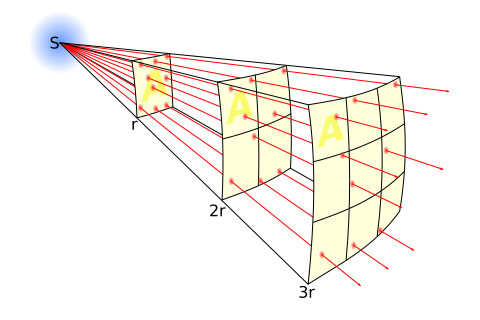
To quote the second greatest font of Internet knowledge, Wikipedia, the physics term known as the inverse square law, “is any physical law stating that a specified physical quantity or intensity is inversely proportional to the square of the distance from the source of that physical quantity. The fundamental cause for this can be understood as geometric dilution corresponding to point-source radiation into three-dimensional space.” (as demonstrated in the diagram… apparently).
In photography, film, and even theatrical lighting – the inverse-square law has been used to determine the lighting “fall off” on a subject as it moves closer to or further from the light source. If you want to get into the physics and the mathematics of how to light well for photography and video, then please feel free to do so. As for me – however… well…
If you are one of the less mathematically-minded types, and you just want a demystified breakdown of how to get light working for you – then Eve Hazelton and the Realm Pictures crew have you covered. I have posted about one of their lighting tutorials before… and I continue to like their style. I hope you will find today’s how-to just as useful.
So today I stumbled on this great little video essay by Kevin B. Lee for Fandor Keyframe. It takes us on journey into one of the key sequences in the film Insomnia. Interestingly, it does so by giving a side-by-side comparison so that we can really drill down into exploring the differences that may be found between the original 1997 Norwegian version (featuring the always impressive Stellan Skarsgård as investigator Jonas Engström), and it’s 2002 Hollywood counterpart (featuring the stupendous Al Pacino as detective Will Dormer).
I think that the work is very well done, and I personally found that it highlights and emphasises what I wrote about in my previous post: when it comes to a thriller, “…we need good pacing. This is critical.” Honestly, I couldn’t have found a better illustration of how much influence pacing has… here we have the exact same story, and the exact same sequence being followed… and yet the emphasis by the directors in each makes for telling differences. Erik Skjoldbjærg is more deliberate, building tension through slower edits. Christopher Nolan on the other hand builds tension by increasing the pace, communicating a more frantic mood. Seriously, you will love this: what a difference timing can make!


 Waiting 2B Scene