Author: sashmiller

  • Video Montage: Walk With Me

    ‘Walk with me.’ It always seems like such a nonchalant thing for a character to say – whether that be in a movie or a TV series.

    Well, maybe that isn’t fair. Perhaps my appreciation of the walk and talk as a clever cinematic device simply wasn’t honed enough to pay any serious attention to it. Don’t get me wrong… I LOVE seeing a quality oner thrown into a piece (despite the subject matter, I think the shot from True Detective remains very close to being my favourite oner/long shot).

    Cue a 6-year old montage that I recently stumbled on that shows just how ubiquitous the walk and talk is as a cinematic device. The time spent choreographing these things amazes me… yet there is an important reason that they remain a go-to feature: namely, they give the scene an opportunity to burn through a whole bunch of detailed information, and they can do it in an interesting manner.

    If you really want to drill down into the nuts and bolts of why these shots are used, then let me suggest that you check out this comprehensive article on the topic.

  • Article: Shoot, Produce, Edit: The Rise of the Pro “Shreditor”

    People love to know their place. Even when a person considers themselves to be unique and counter-cultural, knowing that they are unique and counter-cultural gives them a sense of location in the grand scheme of things.

    That is why I loved reading this article – Shoot, Produce, Edit: The Rise of the Pro “Shreditor” – by the guys at Premium Beats. It actually gives me a named location in the grand scheme of media-making: I am a shreditor. It sounds cool. Almost TMNT’ish.


    I am a Shredder. I mean, a Shreditor.

    How about you? Where do you fit in the media landscape?

  • Blog: My Versatile Pocket Camera

    You know what it’s like right: you are out on a location, and something unexpected happens. Not the bad kind of unexpected – but the good kind. The kind of thing that you wish you had your camera for, all prepped and ready to roll. A versatile pocket camera would be sweet right now, right?

    The fact of the matter is that unless you are on a professional shoot, that simply might not be the case. But imagine if you could load a camera with fully functioning professional settings, in less than 20 seconds. I would at least consider killing for that kind of functionality. The good news is that I never need to.

    I rock around town with a humble Samsung Galaxy S6 in my pocket all the time. In a real bind, this at least gives me the 2-second capacity to take a rough record of what is going down. But then two years ago I discovered an app that many iPhoneographers would be very well acquainted with: FILMiC Pro.

    I love this app. You pretty much have the full manual controls that you would expect from your DSLR or mirrorless cameras – but it is in your phone! Want to take control of the aperture and white balance? That’s not going to be a problem. Feel like exploring the range of focus? Are you kidding? Get in there and set up a fully-fledged rack-pull! Not only that: you can then save all of your settings into a series of presets: imagine being able to run from inside under fluorescent lights, to outside in the bright sun – and handle the transition in next to no time on the same device.

    Seriously … squeezing what professionals do into a workable phone app, FILMiC Pro gives you arguably one of the best video accessories out there. Not convinced? Well, director Sean Baker took an iPhone, used the FILMiC Pro app (with some other cinematic sweetness, it must be said), and shot a short film. In fact, it went on to be theatrically released at Sundance. How sweet is that?!

    Photographer Chase Jarvis famously said that, “The best camera is the one that’s with you.” More than anything else, that is why I have loved having my S6. Constantly in my pocket, I can grab it, double-tap on the home button, and load the in-built camera in just seconds. Should there be a few extra seconds to play with though – then I launch into the FILMiC Pro app, take full control of my settings, and am prepared to make the magic happen.

    This is in no-way a paid advertisement for the guys… I just really love what it brings to the mobile cinematography marketplace. So, if you are interested in taking your phoneography to a new cinematic level – then do yourself a HUGE favour, and get the app today. At worst, it will be the first step in revolutionising your phones camera video quality. At best – it will mean having professional flexibility always on hand, sitting in your pocket. And you will be ready for that unexpected.

  • Video Essay: See What Happens When Scorsese Goes All Quiet

    In our age of twenty-first century cinema, we’re awash with wondrous visual stories and their corresponding soundtracks (though this is no given! Check out our post on how music coming out of the Marvel Cinematic Universe is actually all kind same-same in the sound department).

    It is because of a ubiquitous big-ness of many soundtracks that I would suggest we actually take more notice when a director decides to do things differently. For example, putting in the necessary effort to deftly craft out a film’s sound design with an absence of musical underscoring.

    Cue this amazing little video essay by Every Frame A Painting on the work of Martin Scorsese. Yes, the man is known for his incredible use of music – however, this essay explores his use of silence throughout his 50-years of cinematic experience. So click away, and check out what happens when Scorsese goes all quiet.

  • Top 10: Best Built in Effects in After Effects (SonDuckFilm)

    Okay, I realise that these top tens are always incredibly subjective – and I understand that not everyone will agree with this particular list… in fact, I’m not even 100% convinced that I agree with it. Nevertheless, I love the concept.

    I have been an Adobe aficionado for many, many years (since like, Adobe Premiere… yeah, you read that correctly. Not Adobe Premiere Pro. Just Adobe Premiere!). The years progressed, and I increased my capacity as a run and gun/guerrilla style videographer. That meant having to branch into the widening avenues available in the Adobe Creative Suite. This included upskilling into the world of motion graphics – the wheelhouse of After Effects.

    I guess that is why this list is cool for me. After Effects has something of a special place in my heart: I’m reminded of the countless hours watching tutorials by guys like Video Co-Pilot … being amazed that I was able to make those motion graphics… as well as having a good ol’ laugh at myself for using Trapcode Shine WAY too much in those early works, hahaha.

    Thus this is not only a top ten list of the free in-built effects we currently have access to – but it is also a nostalgic moment of self-reflection. I hope you enjoy! And please free free to like or comment below – let me know what you think!

  • HIMM: What’s With the 29.97FPS?

    HIMM: What’s With the 29.97FPS?

    In a world of HD and 4K – have you ever wondered why your NLE still has 29.97 as a frame rate? I have. Not enough to do my own research into it of course… but it’s always been a question. Like a small splinter in the back of my mind.

    Well, the short answer is that it was an accommodation made when the American’s introduced colour television. If you are interested in the long mathematical version (and the presentation is interesting enough to watch all the way through), then this video essay is just what the doctor ordered.

  • Blog: Employing Symmetry (Part 2)

    Blog: Employing Symmetry (Part 2)

    In part 1, we introduced the idea of engaging with symmetry. The reason for this guide? In the same way that we tend to love patterns, symmetry is like Nutella for our eyes. And if you don’t like Nutella, what’s wrong with you? Seriously… Nutella is great. And peanut butter. Yum. Nutella AND and peanut butter. Om nom nom.

    Anyhoo, I digress.

    Why do we like symmetry so much? No one actually knows. There have been studies that reveal that babies will stare longer at symmetrical pictures than they will at asymmetrical ones. And scientific evidence also suggests that as a species we’re more attracted to symmetrical faces. In short, there is something extremely appealing about symmetry, and we’re drawn to it. So, then, we need to have a really, really good reason to intentionally mess with this particular guide.

    As with most of the visual rules we employ – that is the key. Once we understand how and why it works – and just as importantly, we can make it work ourselves – we can then consider messing with it. Take for example Stanley Kubrick, as he is a great case study for a/symmetrical cinematography:

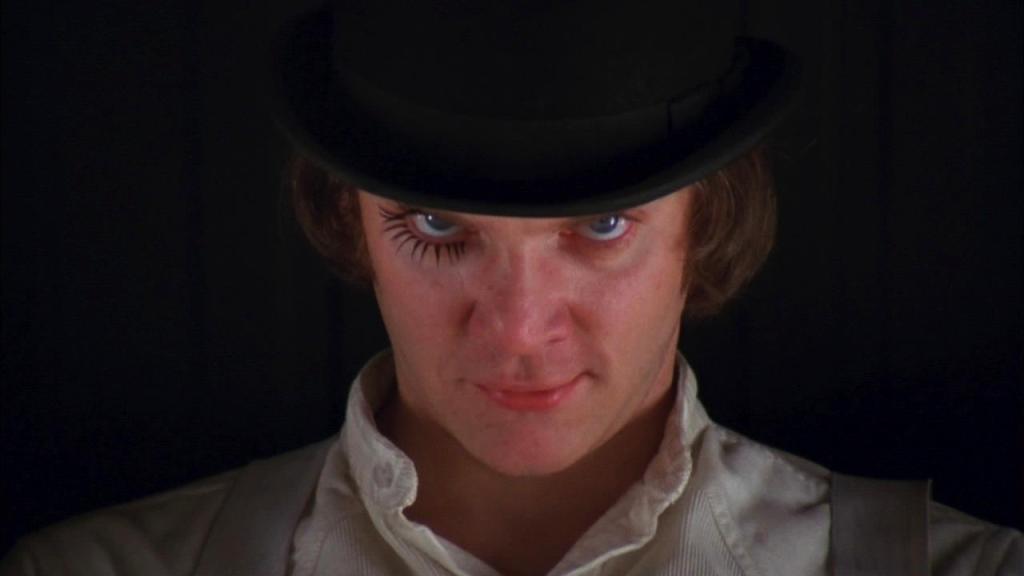
    In cinema what isn’t shown is almost as important as what is. Take the masterful direction of A Clockwork Orange’s opening scene for example.

    Kubrik could have started with a wide shot of the Korova Milk Bar. Instead, he begins with a 16-second straight-on tight shot of Alex’s (the protagonist) face in centre frame. Why? In an instant, he highlights a contrast between symmetry and asymmetry to describe Alex’s madness and deviant behaviour.

    Without uttering a word, the viewer immediately perceives the symmetry. But as the 16-seconds lingers, a visual disquiet makes itself known. In addition to being stared at, there was an alteration to the natural balance: Alex has placed black eyelashes on his right eye only. It is only a tiny detail – and yet it is enough for most viewers to be disturbed by this variation, hinting to them that Alex is not normal. This is then emphasised as the long take begins it’s zoom out.

    Let me say this – and I really can’t stress this enough – there should be no rules when it comes to cinema. Techniques such as symmetrical framing (amongst all the rest) will almost ensure that your image will be aesthetically pleasing. But we do run the risk of creating images that are predictable, common, and quite frankly, boring. Nevertheless – we need to know them, know why they work, know how they work, and know why our piece needs to throw that guide right out the window. Even if it’s by using something as simple as eyelashes.

    Do you have your own thoughts and symmetrical suggestions? Leave a comment below. And if you would like to check out another blog post looking at symmetry, the you can gorge yourself right here.


  • Blog: Employing Symmetry (Part 1)

    If you have ever done research on how to get the right visual shot – whether painted, photographed, or captured in motion – then you probably know the ‘rules.’ This stuff isn’t new. But today I think it’s worth repeating.

    The elephant in the room is that, to misquote the rogue pirate Barbossa, “… the code is more what you’d call “guidelines” than actual rules.” While there is aesthetic appeal with a host of the visual rules that have developed over centuries – the fact is that we can quite easily go ahead and break them. But. Before we do… we really ought to know why the guidelines exist, and why they work first. Then we can decide when and how to best ignore them for our work.

    To demonstrate, take a look at this montage of the cinematographic symmetry (try saying that three times fast!) used in the internationally acclaimed TV series, Sherlock.

    There is something kind of soothing about it, isn’t there? To put it as simply as I can, where the goal of composition is to create a path that is pleasing for the eyes to follow (this is why the guideline exists) – symmetry gives the viewer a vague sense of the harmonious, of beautiful proportions, and of balance (this is why this particular guideline works).

    There are many techniques that will strengthen (or weaken) the symmetric properties of an object or scene. How much of a scene we choose to show is paramount. So too is the position of the camera in relation to the subject, its height, tilt etc. We also need to take particular care to ensure the centre of the composition is equidistant (my word of the day!) to both sides. When done right, it looks simply beautiful. But can you imagine – for example – a shot of the Taj Mahal (an entirely symmetrical structure… right down to its symmetrical reflection in the pools of water around it) that has been misaligned? Well… it would look sort of like this…

    The fact that this image is only slightly out is enough to make it a jarring visual. So while it is possible to break the guidelines of symmetry, if and when we chose to do so, we will really need to go all out. No half measures.

    Coming up in part 2, we will finish looking at how to employ symmetry with another example or two, and some concluding considerations.

  • Tech News: The GH5… The New Face of Change?

    Tech News: The GH5… The New Face of Change?

    Canon and Nikon have been the big boys in the consumer and semi-pro market for like, ever. Most people will kind of remember the moment when Canon released their game-changing Canon EOS 5D Mk II. Though apparently an afterthought by Canon – I don’t think that this is an overstatement: the video capabilities of the updated 5D shifted everything in the world of videography. Ev.’ry.thing.

    That was in 2008 though. 4K video becoming something of an expectation in 2016. So, with the release of the 5D Mk IV earlier this year, Canon (despite the MkII and III being mainstays in many a videographers kit) still seemed to be taking the whole DSLR video thing as an afterthought. Though cynical, perhaps it was to be expected. After all, Canon already has  an extensive cinema and large sensor product line dedicated towards meeting the needs of pro-video and cinema users, right?

    The thing is that while Canon has slept at the wheel since accidentally reinventing how we make videos, tech has continued to move on, advancements have continued, and new players have captured hearts and minds. The current king of the hill would have to be Sony, wooing videographers of all persuasions with the a7S and a7S II. But the proverbial apple cart looks set to be shaken once again, with Panasonic announcing the release of the GH5 in  2017.

    The GH4 has been almost as popular as the Sony a7S – but there are a few little tricks that the latest model is bringing to the game that will arguably push them into first place in the race for mirrorless camera supremacy. For example, you will be able to shoot 10-bit, 60fps 4K footage. Yes!

    We all need to watch this space as full specs and reviews begin to come in. Until then, perhaps you will let Panasonic begin wooing you with this heartwarming prologue.

  • Top Ten: Best Character Reveals

    It’s time to indulge in a guilty pleasure… a little top ten action! To be fair, this list has been very cleverly done and you will find it quite informative. So it is not nearly as guilty watching some of the stuff you can get over at WatchMojo.

    We have all seen them play out in our favourite films haven’t we? The director teases out the introduction of one of the protagonists: a glance here, and hint there. Until finally, boom – there they are, larger than life.

    Well the team at CineFix recently released a pretty great top ten collection of the best movie character reveals, and it’s 15-minutes you won’t be disappointed you watched.