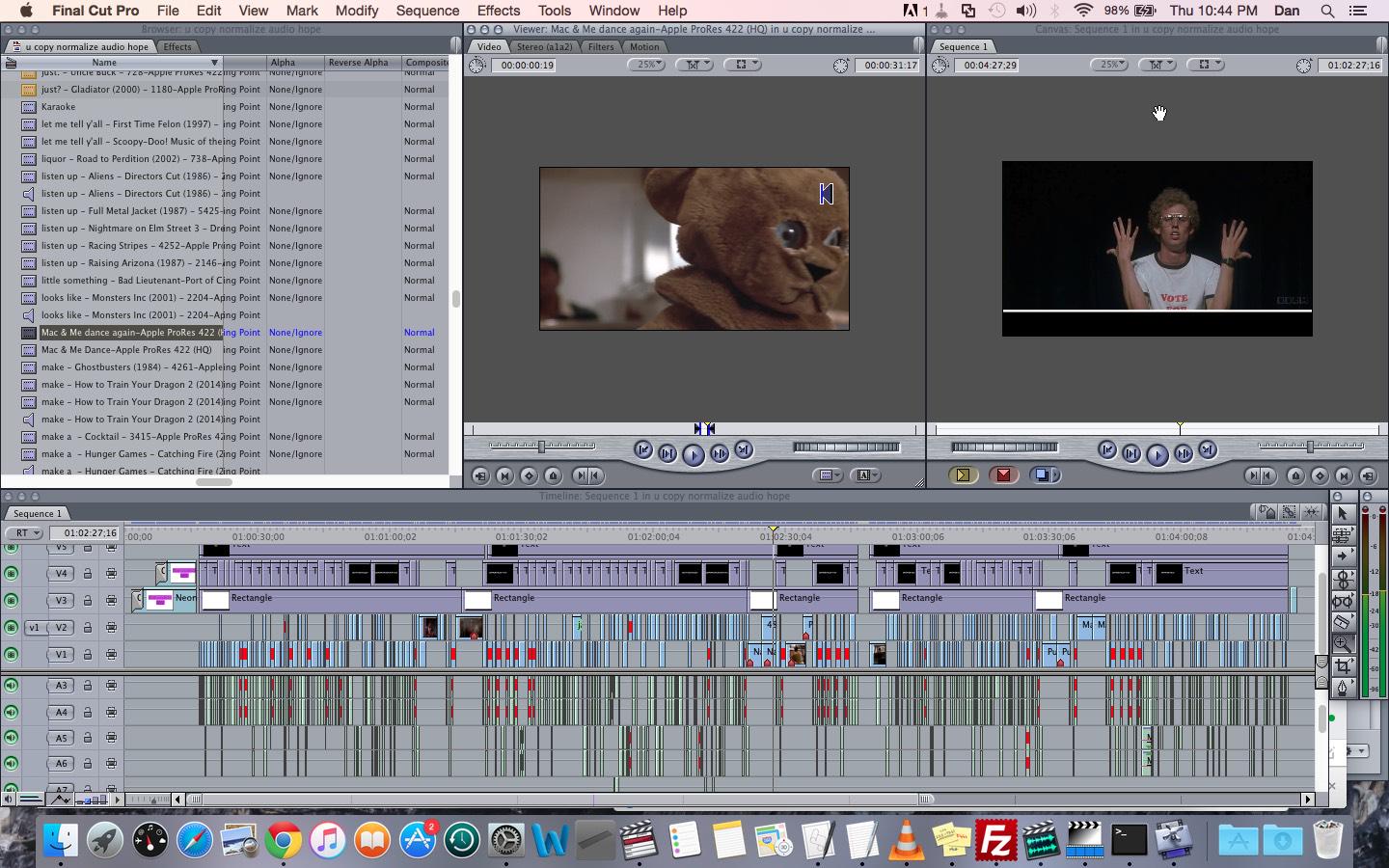
 Okay, so what happens when a person takes 3 months to mix together a whole host – ergo, 280!!! – of Hollywood films and catchphrases with one of the hottest songs of 2014-2015? This awesome piece of mashup goodness – it’s gonna funk you up!
Tag: Resources
-
Music Video Montage: Uptown Funk (Draper)
-
Top Ten: TED Talks on Storytelling and FilmMaking
Alright, you ought to know that I am not a big fan of TED talks. It’s not because they are bad talks per se, it’s just that when a multi-million dollar organisation has pretty much zero internet presence in an internet age (as is the case with the owners of TED – that is the Sapling Foundation), it makes me wonder what agenda is being hidden in the background.
But I digress!
In today’s post, I actually want to share an article which was originally published in April 2014 by the team at Screencraft. It’s one of those guilty pleasure posts, you know. <insert voice of Matt Smith as Dr Who> Top 10 lists are cool! </insert> So check out what constitutes their “10 favorite TED Talks that all filmmakers, screenwriters and storytellers should watch” right here.
If you think it’ll be TLDR, then for brevities sake, their list looks a lot like this (links included):
10. Kevin Alloca: Why Videos Go Viral
09. Elizabeth Gilbert: Your Elusive Creative Genius
08. Rob Legato: The Art of Creating Awe
07. Julian Friedmann: The Mystery of Storytelling
06. Julie Burstein: Four Lessons in Creativity
05. Don Levy: A Cinematic Journey Through Visual Effects
04. Joe Sabia: The Technology of Storytelling
03. James Cameron: Before Avatar … A Curious Boy
02. JJ Abrams: The Mystery BoxAnd their number one TED talk is…
01. Andrew Stanton: The Clues to a Great Story
-
Video Essay: How to Be Tom Cruise (Schneider & Britnell)
Today’s post is a link to a fun little video montage made by Burger Fiction that explores some of the tips and tricks that have gone into the making of US Government operative Ethan Hunt. It is very well done, and you’ll enjoy it I’m sure.
-
How To: Slate Like a Pro
Continuing my series of resource links, today I want to share an excellent how to by the Rocket Jump Film School team.
That moment when your first slate arrives can be pretty exciting. Suddenly you feel a little more professional, you know (well I did). But I had no idea whether there were some common practices when it came to slating. And if you were like me, then those first takes seemed more like an excuse to clap our slates at random intervals rather than being of practical use for the shoot.
Thank goodness they are more than just a fun item to keep on set for the amusement of the crew though. And in this how to, RJFS break down some simple pointers to help you slate a little bit more like a pro. Enjoy!
-
Blog: “Which Lie Did I Tell: More Adventures In The Screen Trade”
As a young 80’s child my grandparents bought me the Little Golden Book Record Read-Along Collection (which featured 20 stories with a corresponding 33.5 rpm vinyl for each story). It sparked a lifelong joy in stories – and to this day I still love to grab a good book and wile away the hours reading.
Having been on holidays for the last few weeks, I have been able to indulge in this favourite pastime of mine (as well as finishing the TV series Fortitude – but that is a different blog post!). So what have I been reading? A pretty great book by screen-writing maestro (and novelist) William Goldman (author and screenwriter of The Princess Bride) entitled, “Which Lie Did I Tell: More Adventures In The Screen Trade”. I picked it up from a charity shop in the London’s Hammersmith for a measly £2 last year… and it is turning into a most excellent little investment!
Now is it all good? No – much of Goldman’s gruff humour and charm derives from emphatic statements of the obvious – and by about half way through, you start to get the feeling that the book may just be devolving into a conspicuous case of sour grapes. BUT, if you are willing to wade past his personal biases (and honestly, what writer isn’t biased? That includes you, Mr/s Reviewer!), then there is some treasure therein. I am not a screenwriter. But you don’t really need to be to enjoy it. There is some advice to wannabe screenwriters as well as some script analysis – but the book is also full of funny anecdotes, uncomfortable truths about Hollywood, and an array of personal insights which have been gleaned from over 40-years in the industry. It is well worth checking it out… especially if you can get it for £2 from a second-hand store like I did.
And that’s it peeps. I am back on board with my blog roll-outs – and look forward to sharing a bunch of great bits and pieces over the next little while!
-
Video Essay: Mad Max: Center Framed (Nedomansky)
Continuing my series of resource links, today I want to return to one of my favourite videography bloggers – Vashi Nedomansky. He recently posted a fantastic little piece that demonstrates the importance of framing and composition.
We often have it drummed into our heads that our framing and composition will look best when it follows simple rules such as the rule of thirds (or perhaps the slightly more complex golden ratio/phi ratio. Don’t know the difference: check this out). And while you can’t exactly argue with the visual efficacy of either of these rules, it’s always nice to be reminded that there are still other alternatives.
Ergo, we come to Vashi’s latest clip. In it, we explore how sequences in the newest edition to the action-packed Mad Max franchise actually work by utilising a centre-framed focus. Though technically it is still working within a rule of thirds/phi ratio framework – it has been a marked deviation from the normal sense of framing for modern action films (which have utilised more of a chaos cinema approach). While, “This is by no means a new technique… by shooting the entire film in this way, [editor] Margaret Sixel could amplify and accelerate scenes, cut as fast as possible with the confident knowledge that the visual information would be understood.” It is a short piece, so I hope you enjoy it.
-
Concept Video: Moments (Haraldsson)
Continuing my series of resource links, today I want to share a fun concept clip that was commissioned by the Icelandic telecommunications company Síminn a couple of years ago.
If you have done any manner of research into equipment for video and film shoots, then you will know that there is an abundance of recommendations: you need to get this camera, or that type of lens, or this kind of bundled kit. And, of course, each one of those recommendation is the must have. Here is a little something that I have learnt: they are only a recommendation. In fact, unless you have specifically given the unique and particular needs of your shoot and have asked for specific assistance, it will not be an equipment gospel that you need to stick with (I know, I can hear the collective gasp of every blogging videographer from here… relax everyone, I’m not preaching heresy – just let me make my point before you stone me).
What we need to do is to take those recommendations, and then assess whether the suggestions offered meets the needs of our shoot. It is all about knowing which tools will actually best suit the job you are working on. That is the basis for today’s post (collective sigh of relief from videographer blogosphere).
So lets come back to the video: created by Harald Haraldsson, this concept clip (and I am including the BTS for your pleasure too) was shot entirely on a Samsung Galaxy S3. You read that correctly. And S3. While there is an incredible array of (technically, and visually) better recommendations for a professional video shoot – the tool that happened to be necessary for this particular job ended up being the comparatively simple smartphone.
It is easy to get overwhelmed with the latest and greatest options. So take some time to consider what your shooting needs will be, and then go about finding out what equipment will best help your realise that visual dream. Sure, it might be something really nice like an Arri or a Red. But you know what – all it may take is a humble smartphone (or a DSLR, or a GoPro, or a BMDPCC) to actually get the job done.
-
Video Montage: Cinema in Cinema (Paredes)
Continuing my series of resource links, today I want to share a fun little video montage by Spanish videographer Eusebio Poveda Paredes – namely his homage to cinema in cinema.
Featuring an amazing 139 clips from 93 different films – there is not a whole lot to add to the joy of simply diving in – so please do, and enjoy this fun little labour of love.
-
How To: Blend Mode Colour Correction in Premiere Pro (Lynda)
Continuing my series of resource links, today I want to share a great little Adobe Premiere Pro tutorial by the ever resource-driven team at Lynda.
If you make videos, then you ought to know that good videos have been treated in order to make the colour consistent. Just think – how many Hollywood blockbusters would you have avoided if the production companies hadn’t entrusted a colour-grading specialist to overlay the ubiquitous (and film critic nightmare) “orange and teal” colour system? More than a few I would wager!
 Case in Point…
Despite Hollywood’s apparent reluctance to stray too far afield of their orange and teal ideal over the last 20 years or so (though to be fair, there have been other stereotyped colour visuals employed – for example, stark, or bleached white scenes depicting the future… warm orange scenes depicting the inside of a medieval inn… blues and/or greens employed to depict science fiction… you get the picture) – we shouldn’t throw the proverbial baby out with the bathwater. Colour grading ought to be an indispensable element of the video-maker’s production schedule. But what if you don’t have the budget to hire a colour grader? What if, like me, you are more an indie-shooter that quite often produces the work from top-to-tail in a guerilla fashion? Are we to be left at the mercy of the raw footage? In short, no… there are tips and tricks that we can employ to help us smooth out our work too. And this video is one such tip.
Adobe’s Premiere Pro can afford us with a unique – and visually-pleasing – result by employing some basic blending and adjustment layer functions. And as noted by the No Film School post on this same clip, author “Ashley Kennedy recently shared some extremely helpful tips for using blend modes to correct exposure and contrast issues, as well as some tips for using blend modes to create color casts.”
Is it perfect? No. It may not even be ideal. But when you are on your own, or are in a seriously bad way with your footage – then this might be just the kind of trick that can help you to salvage something out of the situation. I hope you enjoy.
-
Video Essay: That’s Just Too Much Johnson Welles!
Continuing my series of resource links, today I want to share a short video essay that interestingly brings to light the more humble beginnings of Orson Welles.
74-years after crafting a picture that tells a simple, subtle story that works brilliantly in capturing our attention from the first frame onwards, Orson Welles still inspires. And for many cinephiles, the greatness of Citizen Kane is inextricably linked to the fact that the masterpiece was Welles’ debut work. Even so, whether it was his first or thirteenth film – there ought to be no disagreement that it stands as one of the most arresting films ever produced.
Having said that, Welles did in fact have pre-Kane films. The relatively recent 2014 surfacing of his 1938 work Too Much Johnson is an excellent case in point. Though somewhat rudimentary – we can see elements of the master technician practising his craft at least 3-years before Kane’s release. The work also does a lot to dispel the occasional assertion that Welles was a cinematic naif unschooled in the basic grammar of film. Oh, there is so much that may be discussed about this… but rather than bore you with my own verbage, let me rather introduce you to this little video essay by Kevin B. Lee on the whole matter.
Note: allow me to add this – I find it absolutely fascinating that the surviving film elements of Too Much Johnson somehow ended up in an Italian warehouse before being acquired by the USA’s National Film Preservation Foundation! It is almost as fascinating as the man himself!
 Waiting 2B Scene