Tag: Resources

  • How To: The Inverse Square What? (Hazelton)

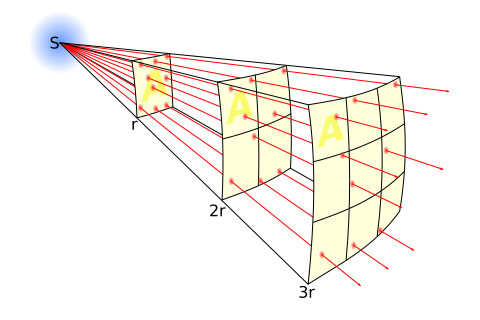
    To quote the second greatest font of Internet knowledge, Wikipedia, the physics term known as the inverse square law,  “is any physical law stating that a specified physical quantity or intensity is inversely proportional to the square of the distance from the source of that physical quantity. The fundamental cause for this can be understood as geometric dilution corresponding to point-source radiation into three-dimensional space.” (as demonstrated in the diagram… apparently).

    In photography, film, and even theatrical lighting – the inverse-square law has been used to determine the lighting “fall off” on a subject as it moves closer to or further from the light source. If you want to get into the physics and the mathematics of how to light well for photography and video, then please feel free to do so. As for me – however… well…

    If you are one of the less mathematically-minded types, and you just want a demystified breakdown of how to get light working for you – then Eve Hazelton and the Realm Pictures crew have you covered. I have posted about one of their lighting tutorials before… and I continue to like their style. I hope you will find today’s how-to just as useful.

  • Video Montage: Keeping The Distance (Between the Frames)

    Last time I shared a video essay and an article that opened up on the whole idea of framing beyond the rule of thirds. Well today I want to continue in that vein with this great little piece by the Between the Frames channel over at Vimeo. As written in the description, “This video explores how director Bennett Miller consistently uses wide shots throughout Foxcatcher to highlight the physical and emotional distance between characters, their situations and how we, the audience relate to them.”

    Honestly, the montage of all of these elements might leave you feeling a little cold: but it is well worth watching and seeing how much an effect celever framing can have.

  • Article/Video Essay: Beyond the Rule of Thirds/The Quadrant

    Whether you started out in photography, or you were dumped into the deep end of video and film – you will know of the rule of thirds (RoT). It’s one of those unstoppable forces that influence every aspect of both!

    Like many “rules” in avenues of artistic endeavour, the RoT is an excellent starting point – particularly if you haven’t yet developed an instinct for good visual composition. Once you know the why and how behind effectively utilising the RoT, however, you ought to expand your visual vocabulary – developing visuals that aren’t necessarily tied down to the RoT (I can’t help but think of Barbossa here: “the code is more what you’d call “guidelines” than actual rules.”).

    So if you are willing to wade out into the deeper waters of visual framing and composition, then this article by Doddle offers a great variety of framing illustrations that go beyond the rule of thirds: the golden spiral, quadrants, diagonals, the centre, as well as playing around with the edges and intentionally unbalancing the frame.

    If you happen to want a more in-depth video essay to help you shake your RoT shackles, then look no further than this great example by the Every Frame of Painting YouTube channel – it breaks down the quadrant system of framing that was used in the 2011 film Drive. Enjoy!

  • Video Essay: Side-By-Side Comparison of Insomnia (Lee)

    So today I stumbled on this great little video essay by Kevin B. Lee for Fandor Keyframe. It takes us on journey into one of the key sequences in the film Insomnia. Interestingly, it does so by giving a side-by-side comparison so that we can really drill down into exploring the differences that may be found between the original 1997 Norwegian version (featuring the always impressive Stellan Skarsgård as investigator Jonas Engström), and it’s 2002 Hollywood counterpart (featuring the stupendous Al Pacino as detective Will Dormer).

    I think that the work is very well done, and I personally found that it highlights and emphasises what I wrote about in my previous post: when it comes to a thriller, “…we need good pacing. This is critical.” Honestly, I couldn’t have found a better illustration of how much influence pacing has… here we have the exact same story, and the exact same sequence being followed… and yet the emphasis by the directors in each makes for telling differences. Erik Skjoldbjærg is more deliberate, building tension through slower edits. Christopher Nolan on the other hand builds tension by increasing the pace, communicating a more frantic mood. Seriously, you will love this: what a difference timing can make!

    https://vimeo.com/137388966

  • Blog/Video: Thriller Horror on a Budget (Simon Berry)

    If there is anything that a film such as Paranormal Activity can demonstrate, it is that a creative idea doesn’t actually need an extravagant budget in order to be brought to life. I would argue that is especially true when it comes to the thriller/horror genre. And I will share a video that demonstrates that quite nicely. But first…

    For the sake of my blog space I want to touch on just two (of the admittedly many!) components that contribute to the success of a thriller or horror. If you would like more, well, Google will be your friend.

    Firstly, we need a good story. In a large majority of thrillers and horror films alike we will find a variation of this common theme: protagonist falls victim to someone/something else’s scheme – gets stuck in a moment of dread. There is a reason for that: it lends itself to being a good story. What happens to the protagonist? Do they get out? Are they overcome? Why does this other person/thing want the protagonist involved at all?  Etc etc etc. Exploring this style of thriller doesn’t need a big budget to be brought to life: just an intuitively thrilling way for the story to be told.

    Secondly, we need good pacing. This is critical. Just think about the master of suspense, Alfred Hitchcock. Seriously. The guy was able to develop a proverbial stranglehold on his audiences! I recently read some reviews that suggested Hitchcock was slow and stodgy in his work – honestly, the effects of the reduction in attention span have clouded their judgement! Thrillers and horror are all about the suspense and the tension – and mark my words, Hitchcock was the best at that genre… and he held the mantle for a very long time. He was a maestro who knew how to effectively pace his stories in order to build the suspense. Like all thrillers, he was able to keep the audience in that constant tension of asking, “What comes next?”

    So then – let us turn our attention to the video part of today’s blog. This is fresh off the press, and is a little gem. At under 4 minutes, Simon Berry does wonders with this short thriller/horror. And more to the point – he did so with just a two day turn-around, and working with a micro-budget! He crafts a simple story, and builds tension with the pacing. Simple, yet effective. I think you will enjoy it.

  • Review: Smartphone Stabilisation

    Even though there are lots of stabilising options out there, today I wanted to share a recent clip by the FilmRiot team who have reviewed the US$379 iKan Fly-X3 Plus 3-axis brushless motor gyro stabilising system. Specifically for use with smartphones, it doesn’t look too bad. Even though it is probably a little on the expensive side, this seems like it might still be a nice little piece of kit: and as we all know, having the right tools for the job is as important an aspect of videography as what happens in front of the lens. Enjoy.

  • Video Montage: When Shadows Become Characters (Skorkin)

    So today I was doing my usual perusal of Vimeo (come on now – you know that a key component of the twenty-first century creative process is random internet surfing, right?) when I stumbled on this fresh little piece.

    If you are involved in creative video or film of any sort, then you know a little something about lighting. What I love about this piece is that it demonstrates a variety of ways that cinematographers have grabbed that simple (albeit in a profound kind of way) element of videocraft – ie, lighting – and twisted it into a character in it’s own right. I hope you enjoy it too.

  • How To: Stop Frame Animation (Stop-Motion/Claymation)

    So today’s video how-to one was of personal interest to me, as one of my international colleagues asked the question about whether we could try to pull together a claymation clip for one of our up-and-coming projects. I had no idea… and even though my production manager was reluctant, at least we were given the green light to explore the idea, which was great news!

    So how do you go about trying something you know nothing about? You learn about it. And if you have ever wondered how to do stop frame animation, then I hope this video will be as useful to you as it has been to me this week.

  • Interview: William Goldman (The Writer Speaks)

    Given that I have been reading his book, it ought to come as no surprise that I have finally stumbled upon an interview with William Goldman.

    Released back in 2013 by The Writer Speaks – you get access to quite an influential Hollywood writer and author for an hour and a half.  Deciding to watch this through is definitely a commitment – however, deciding not to would be ill-advised. Honestly, it is less time consuming than reading through the books – and it is worth watching. So do yourself a favour and check it out already. 🙂

  • Video Essay: Directed By Christopher Nolan (Malko)

    As I wrote recently, I have been reading William Goldman’s book, “Which Lie Did I Tell: More Adventures In The Screen Trade”… a consequence of the reading has been to dull the sheen of the apparent super-powers that directors like Christopher Nolan have always seemed to possess. With that being said – great directors are very much a Ring Master at the Cinema Circus. We all know that there is no show without the talent (everyone from the screen writers, the cinematographers, the sound designers, the actors, and everyone else in between). Likewise, the Cinema Circus must have a Ring Master that can pull it all together and offer the audience as seamless a production as possible.

    Thus today I would like to share a video essay put together by a young Ukrainian videographer, Nikita Malko. Even though it falls into that trap of glorifying Nolan alone amongst his talented crew – it is still a fun little montage.

    https://vimeo.com/134932028