Tag: Planning

  • Blog: Employing Symmetry (Part 1)

    If you have ever done research on how to get the right visual shot – whether painted, photographed, or captured in motion – then you probably know the ‘rules.’ This stuff isn’t new. But today I think it’s worth repeating.

    The elephant in the room is that, to misquote the rogue pirate Barbossa, “… the code is more what you’d call “guidelines” than actual rules.” While there is aesthetic appeal with a host of the visual rules that have developed over centuries – the fact is that we can quite easily go ahead and break them. But. Before we do… we really ought to know why the guidelines exist, and why they work first. Then we can decide when and how to best ignore them for our work.

    To demonstrate, take a look at this montage of the cinematographic symmetry (try saying that three times fast!) used in the internationally acclaimed TV series, Sherlock.

    There is something kind of soothing about it, isn’t there? To put it as simply as I can, where the goal of composition is to create a path that is pleasing for the eyes to follow (this is why the guideline exists) – symmetry gives the viewer a vague sense of the harmonious, of beautiful proportions, and of balance (this is why this particular guideline works).

    There are many techniques that will strengthen (or weaken) the symmetric properties of an object or scene. How much of a scene we choose to show is paramount. So too is the position of the camera in relation to the subject, its height, tilt etc. We also need to take particular care to ensure the centre of the composition is equidistant (my word of the day!) to both sides. When done right, it looks simply beautiful. But can you imagine – for example – a shot of the Taj Mahal (an entirely symmetrical structure… right down to its symmetrical reflection in the pools of water around it) that has been misaligned? Well… it would look sort of like this…

    The fact that this image is only slightly out is enough to make it a jarring visual. So while it is possible to break the guidelines of symmetry, if and when we chose to do so, we will really need to go all out. No half measures.

    Coming up in part 2, we will finish looking at how to employ symmetry with another example or two, and some concluding considerations.

  • Concept Video: Moments (Haraldsson)

    Continuing my series of resource links, today I want to share a fun concept clip that was commissioned by the Icelandic telecommunications company Síminn a couple of years ago.

    If you have done any manner of research into equipment for video and film shoots, then you will know that there is an abundance of recommendations: you need to get this camera, or that type of lens, or this kind of bundled kit. And, of course, each one of those recommendation is the must have. Here is a little something that I have learnt: they are only a recommendation. In fact, unless you have specifically given the unique and particular needs of your shoot and have asked for specific assistance, it will not be an equipment gospel that you need to stick with (I know, I can hear the collective gasp of every blogging videographer from here… relax everyone, I’m not preaching heresy – just let me make my point before you stone me).

    What we need to do is to take those recommendations, and then assess whether the suggestions offered meets the needs of our shoot. It is all about knowing which tools will actually best suit the job you are working on. That is the basis for today’s post (collective sigh of relief from videographer blogosphere).

    So lets come back to the video: created by Harald Haraldsson, this concept clip (and I am including the BTS for your pleasure too) was shot entirely on a Samsung Galaxy S3. You read that correctly. And S3. While there is an incredible array of (technically, and visually) better recommendations for a professional video shoot – the tool that happened to be necessary for this particular job ended up being the comparatively simple smartphone.

    It is easy to get overwhelmed with the latest and greatest options. So take some time to consider what your shooting needs will be, and then go about finding out what equipment will best help your realise that visual dream. Sure, it might be something really nice like an Arri or a Red. But you know what – all it may take is a humble smartphone (or a DSLR, or a GoPro, or a BMDPCC) to actually get the job done.

  • Video Essay: Rear Window (Michael McLennan)

    Continuing my series of resource links, today I want to share a short clip that was pieced together by one of my friends, Michael McLennan. Michael also happens to be a long-time cinephile who has worked as producer, director of photography, editor, sound designer, music editor, and has also taught across a variety of film disciplines at the Sydney Film School. Recently picked up by the Indiewire team, today’s clip is a simple video essay that demonstrates Hitchcock’s amazing capacity for structural story-telling. In this instance, we find the story engaging with the audience through a carefully constructed repetition of symmetry.

    I personally find that such examples really ought to reinforce the idea that while amateurs point and shoot and think something along the lines of, “I hope this will look good!” – professionals plan and plan and plan, thinking more along the lines of, “How do I want this to look?” If we want to up our game and get our work seen – then we can all continue to learn tricks from the masters of cinema like this. I hope you enjoy.

  • Video Article: Understanding Jump Cuts

    Continuing my series of resource links, today I want to share a video I stumbled on a little while ago. Coming from Vimeo’s Riley Hooper, it offers a pretty concise explanation of the technique known as a jump cut. Even if you have never heard the term before, I can guarantee that you all know what a jump cut looks like… though picking up pace in more and more places, it is a ubiquitous transition amongst the most popular of YouTube’s vloggers. As someone cleverly observed, “Anything other than a jump cut would create a slower experience that would leave you less stimulated and thus more likely to click away.”1

    So, jump right in. 🙂

  • I Shot the Deputy

    To this day my Dad loves listening to songs from his generation on the radio. And while I have come to appreciate some of the old classics: it still drives me up the wall that I am not able to listen to more modern music if Dad is around! Hence the title of today’s blog: in moving along with the importance of planning, it seemed funny to me that the first thing that came to mind when considering the title for today’s post was Bob Marley’s I Shot the Sheriff.

    Moving on, let’s get into the point of the post: planning our shots. Some might find this line of thinking a bit simple. In a number of ways, I’ve personally come to love the KISS principle when it comes to video making. Why should we make things more difficult than they need to be? Now don’t get me wrong: if you want in depth, I can absolutely appreciate that – and can even do that – it’s just that this blog isn’t where that’s going to happen. Maybe I’ll write a book one day. 🙂

    Now, in the last post we looked at the importance of establishing our shoot plan: do you recall this Videomaker quote: “When you plan like a pro, you: Plan the shoot in pre-production, shoot the plan in production, and edit the planned shoot in post-production.”? Once we have a plan for our shoot, we’re ready to begin planning individual shots. And though it may seem obvious, it needs to be said that we ought to have a reason for every shot. How may we start that process? By asking ourselves a couple of simple questions, such as:

    • What are we trying to achieve with this shot?
    • Is this necessary?
    • Is there already a shot that’s essentially the same?
    • Is our audience going to connect with the intention of this shot?

    “In any of the arts, the first step toward excellence is mastering technique – learning to use a specific technology skilfully and effectively.” (O’Brien & Sibley, 1995) When you, the videographer, use a camera creatively, planning your shots well – it changes from a simple, mechanical tool into an artist’s tool. Instead of making a random collection of seemingly unrelated images, it begins to communicate a story (if done well).

    There is an excellent exposition of the opening sequence of the original The Terminator film that I would like to reference here for a few minutes.

    Terminator Opening Sequence

    Image Source: http://cinevenger.com/wp-content/uploads/2012/03/vlcsnap-2012-03-15-20h59m01s15.png. Used under ‘Fair use’ (Copyright Act of 1976, 17 U.S.C. § 107)

    In the opening series of shots we are drawn into a futuristic, cyborg-dominated world without a word being spoken. That is the shoot plan. But how did they achieve that? Both James Cameron, as director, and Adam Greenberg, as director of photography, would have spent a great deal of time setting up the necessary sequence of shots needed to achieve that end. Like the first question above asks, they would have discussed what they were trying to achieve with each shot. And as you will see in this sequence – they chose to use low angled shots almost exclusively. In planning their shots, the audience immediately gets drawn into the narrative through a brilliant combination of visual (and audio) cues. If you want the full breakdown, check out the link to the exposition.

    For our purposes today, what can we practically take away from this example?

    Firstly, I would suggest that you take the time to get each shot right, especially if it’s an important one. You don’t want a low angled shot if you’re trying to visually communicate equality or submission.

    Secondly, if you are just starting out in videography, ensure that you leave at least 5 seconds of footage at the beginning and end of every single shot as a safety buffer. Professionals already know this one, as there is a sequence of calls used for each shot (lock it down, speed, and action).

    Thirdly, as a rule, concentrate on quality rather than quantity. Well-planned shot selection will eliminate overall resource waste. Too much material not only wastes time (and battery power), but it will make the eventual editing a much harder job. Be ready to get a few different versions of the shot – but only if it’s absolutely necessary. As much as possible, plan your shots first so you don’t need to work on an alternative.

    When you plan beyond the viewfinder you’ll find that you’ll save yourself time in the long run. Thorough production planning allows us to foresee problems that may arise during production, gather the required equipment for both the shoot and the individual shots, and to plan as many of the details as we can ahead of time. Sure – you will get the opportunity to cut stuff out later. But riddle me this: if you know that you’re going to do that, then why shoot it in the first place?

  • Can’t I Just Shoot Them?

    The last thing most amateurs consider when making a video (or taking photos for that matter) is the planning. And if it does cross their mind, they might still miss the weight of its importance. Today I want to highlight this vital area of production.

    The truth is that a good plan is important; and is perhaps one of the most difficult things to master. Most people just pick up a camera – whether it’s for video or for photography – and shoot happy snaps. In the book, Top Travel Photo Tips from Ten Pro Photographers, photographer Michael Doven notes that, “If you plan a photo session in advance, no matter where you travel, you’ll shoot images you’ll be proud of nearly every time.” Honestly, lots of energy should be spent on getting this right. Spud Hilton at the blog SFGate wrote that, “Digital cameras are a double-edged sword. Not so long ago, each time you released the shutter, it cost you at least 50 cents in film and processing. Now it costs next to nothing — and that’s exactly how much effort most people put into taking a photo.” This is true for videography as much as it is for photography, with stats showing 72 hours of video is uploaded to YouTube every minute!

    If you want your work to be seen, then let me encourage you to consider this: the first thing that really separates the amateurs from the pros is that amateurs will simply point and shoot, whereas the pros will plan and shoot. Sure, sometimes we won’t have time to prepare as the action begins unexpectedly and we just have to go for it.  As far as possible, though, we plan as we go. It can’t be stressed enough: planning is everything.

    So how do we start planning? Well, we’ll look at that over the next couple of blog entries by exploring the two key components that every photographer and videographer ought to be well acquainted with: the “Shoot Plan” and the “Shot Plan.”

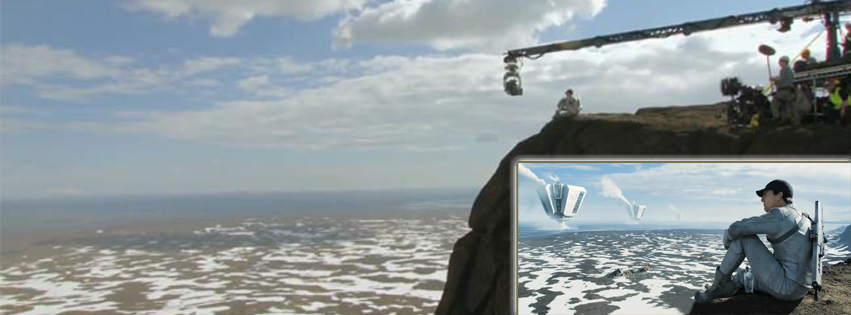
    Oblivion Production Photo

    (Production still – with final insert – from the film Oblivion. This single cliff-top scene took a 60-person crew to shoot. You can’t shoot with 60 people unless you have a plan!)