Tag: Photography

  • Blog: Employing Symmetry (Part 1)

    If you have ever done research on how to get the right visual shot – whether painted, photographed, or captured in motion – then you probably know the ‘rules.’ This stuff isn’t new. But today I think it’s worth repeating.

    The elephant in the room is that, to misquote the rogue pirate Barbossa, “… the code is more what you’d call “guidelines” than actual rules.” While there is aesthetic appeal with a host of the visual rules that have developed over centuries – the fact is that we can quite easily go ahead and break them. But. Before we do… we really ought to know why the guidelines exist, and why they work first. Then we can decide when and how to best ignore them for our work.

    To demonstrate, take a look at this montage of the cinematographic symmetry (try saying that three times fast!) used in the internationally acclaimed TV series, Sherlock.

    There is something kind of soothing about it, isn’t there? To put it as simply as I can, where the goal of composition is to create a path that is pleasing for the eyes to follow (this is why the guideline exists) – symmetry gives the viewer a vague sense of the harmonious, of beautiful proportions, and of balance (this is why this particular guideline works).

    There are many techniques that will strengthen (or weaken) the symmetric properties of an object or scene. How much of a scene we choose to show is paramount. So too is the position of the camera in relation to the subject, its height, tilt etc. We also need to take particular care to ensure the centre of the composition is equidistant (my word of the day!) to both sides. When done right, it looks simply beautiful. But can you imagine – for example – a shot of the Taj Mahal (an entirely symmetrical structure… right down to its symmetrical reflection in the pools of water around it) that has been misaligned? Well… it would look sort of like this…

    The fact that this image is only slightly out is enough to make it a jarring visual. So while it is possible to break the guidelines of symmetry, if and when we chose to do so, we will really need to go all out. No half measures.

    Coming up in part 2, we will finish looking at how to employ symmetry with another example or two, and some concluding considerations.

  • Video Blog: Shooting on an Old Lens (Mathieustern Production)

    Ever wondered what might happen if you attached a really old-school lens onto your mirrorless camera? I have. Fun fact, Mathieu Stern (Mathieustern Production) has wondered about this too.

    Releasing the first part of his new web-series on Monday, Stern – a French web video producer and photographer based in Paris – is focusing solely on what kind of “weird” lenses can be mounted on a mirrorless digital camera. The premise is simple and elegant: what visuals can come of such mismatched pairings?

    In this first clip, Stern tests a 1910 folding camera lens on a Sony A7II: going through several steps, an Eastman Kodak Kodex / Topaz Boyer Paris f6.3 120mm is finally let loose upon the digital landscape! If you’re familiar with the properties of old lenses, you probably won’t be too surprised by the look of the final footage. Nevertheless, I still find the finished result nostalgically pleasing.

  • Product Preview: Light L16 Camera

    Many moons before I began playing in the world of videos, I was a fairly avid amateur photographer. As a kid my grandfather introduced me to the world of photography, and I was hooked. While it has felt like a natural transition from photography to videography, those humble origins still lead me to check out fantastic new developments (pun intended!) that are happening in the world of still-life technology.

    Today I happened on a new video that is promoting a completely new kind of stills camera (that also has 4K video capacity it must be said): the Light L16. All I will say about the whole thing is, well…. giggity.

    https://vimeo.com/141273968

  • How To: Colouring Compliments in Photoshop

    Continuing my series of resource links, today I want to share an excellent tute that goes through some mid-level colour correction using Photoshop.

    Now why on earth would I want to share a Photoshop tutorial on a blog that has to do with videography and the like? The simple reason is that I like the presenter. That and the fact that understanding how to utilise complimentary colours is one of those fundamental techniques we all ought to be aware of, regardless of whether the images we work with are still or moving.

    Those who have learned their colour-jiu-jitsu are generally the ones that have been able to progress from a mobile phone kind of photographer/videographer that needs Instagram filters to help prop up their shots. Take it from me – tutes like this one are a great way of building up your skill set in this area. I hope you enjoy it.

  • Article: Stills Photographer Intro to Video (RED)

    Continuing my series of resource links, today I want to share a great article that was published a while back by those in the RED Universe. Really, there’s no surprises here as the title says it all: it is an introduction to video production for those of you who are photographers. Granted, many of you may know this stuff. Nevertheless, if you are just starting to play around with the video functionality on your DSLR – or you have never really dug into the kind of background information that can make your videos a little better – then this article is a must. I hope you find it useful.

    “This article gives an overview of the key differences in order to make the “cinephotography” transition as straightforward as possible…”

  • Can’t I Just Shoot Them?

    The last thing most amateurs consider when making a video (or taking photos for that matter) is the planning. And if it does cross their mind, they might still miss the weight of its importance. Today I want to highlight this vital area of production.

    The truth is that a good plan is important; and is perhaps one of the most difficult things to master. Most people just pick up a camera – whether it’s for video or for photography – and shoot happy snaps. In the book, Top Travel Photo Tips from Ten Pro Photographers, photographer Michael Doven notes that, “If you plan a photo session in advance, no matter where you travel, you’ll shoot images you’ll be proud of nearly every time.” Honestly, lots of energy should be spent on getting this right. Spud Hilton at the blog SFGate wrote that, “Digital cameras are a double-edged sword. Not so long ago, each time you released the shutter, it cost you at least 50 cents in film and processing. Now it costs next to nothing — and that’s exactly how much effort most people put into taking a photo.” This is true for videography as much as it is for photography, with stats showing 72 hours of video is uploaded to YouTube every minute!

    If you want your work to be seen, then let me encourage you to consider this: the first thing that really separates the amateurs from the pros is that amateurs will simply point and shoot, whereas the pros will plan and shoot. Sure, sometimes we won’t have time to prepare as the action begins unexpectedly and we just have to go for it.  As far as possible, though, we plan as we go. It can’t be stressed enough: planning is everything.

    So how do we start planning? Well, we’ll look at that over the next couple of blog entries by exploring the two key components that every photographer and videographer ought to be well acquainted with: the “Shoot Plan” and the “Shot Plan.”

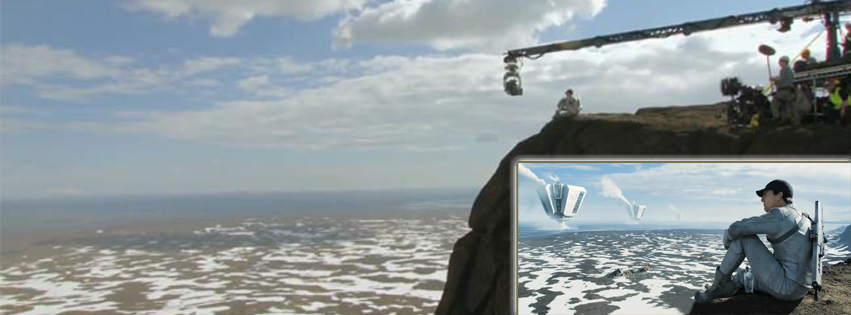
    Oblivion Production Photo

    (Production still – with final insert – from the film Oblivion. This single cliff-top scene took a 60-person crew to shoot. You can’t shoot with 60 people unless you have a plan!)