Tag: film and television

  • How To: The Inverse Square What? (Hazelton)

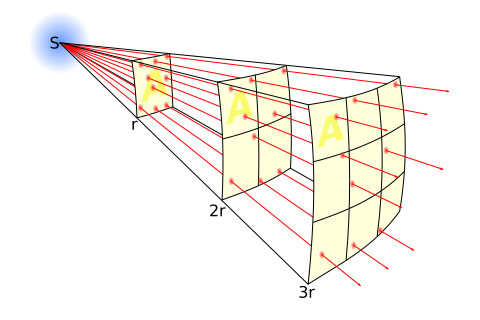
    To quote the second greatest font of Internet knowledge, Wikipedia, the physics term known as the inverse square law,  “is any physical law stating that a specified physical quantity or intensity is inversely proportional to the square of the distance from the source of that physical quantity. The fundamental cause for this can be understood as geometric dilution corresponding to point-source radiation into three-dimensional space.” (as demonstrated in the diagram… apparently).

    In photography, film, and even theatrical lighting – the inverse-square law has been used to determine the lighting “fall off” on a subject as it moves closer to or further from the light source. If you want to get into the physics and the mathematics of how to light well for photography and video, then please feel free to do so. As for me – however… well…

    If you are one of the less mathematically-minded types, and you just want a demystified breakdown of how to get light working for you – then Eve Hazelton and the Realm Pictures crew have you covered. I have posted about one of their lighting tutorials before… and I continue to like their style. I hope you will find today’s how-to just as useful.
  • Article/Video Essay: Beyond the Rule of Thirds/The Quadrant

    Whether you started out in photography, or you were dumped into the deep end of video and film – you will know of the rule of thirds (RoT). It’s one of those unstoppable forces that influence every aspect of both!

    Like many “rules” in avenues of artistic endeavour, the RoT is an excellent starting point – particularly if you haven’t yet developed an instinct for good visual composition. Once you know the why and how behind effectively utilising the RoT, however, you ought to expand your visual vocabulary – developing visuals that aren’t necessarily tied down to the RoT (I can’t help but think of Barbossa here: “the code is more what you’d call “guidelines” than actual rules.”).

    So if you are willing to wade out into the deeper waters of visual framing and composition, then this article by Doddle offers a great variety of framing illustrations that go beyond the rule of thirds: the golden spiral, quadrants, diagonals, the centre, as well as playing around with the edges and intentionally unbalancing the frame.

    If you happen to want a more in-depth video essay to help you shake your RoT shackles, then look no further than this great example by the Every Frame of Painting YouTube channel – it breaks down the quadrant system of framing that was used in the 2011 film Drive. Enjoy!

  • Blog Video: Sherlock Recut As a Thriller Trailer

    Throughout this year my workload has been focused primarily on editing and producing a series of women’s self-help modules. It is necessary work, and based on the stories that have come out of it – it is seeing some wonderful results. Still, it is hardly creative work.

    Well, yesterday I re-stumbled on a great little article by No Film School on how to help get past a bit of a creative funk: so I decided to give it a go. After having a look at some of the footage I had saved on my HD, I decided to do a re-cut version of the very first episode of Sherlock. In a trailer style for a thriller. Aaaand just 2-hours later, this is what I come up with. I’m not a sound stylist, so that side of things is a bit rough. Still, it was definitely a pleasure to stretch out some of the other creative muscles.

  • Review: Smartphone Stabilisation

    Even though there are lots of stabilising options out there, today I wanted to share a recent clip by the FilmRiot team who have reviewed the US$379 iKan Fly-X3 Plus 3-axis brushless motor gyro stabilising system. Specifically for use with smartphones, it doesn’t look too bad. Even though it is probably a little on the expensive side, this seems like it might still be a nice little piece of kit: and as we all know, having the right tools for the job is as important an aspect of videography as what happens in front of the lens. Enjoy.

  • Video Montage: When Shadows Become Characters (Skorkin)

    So today I was doing my usual perusal of Vimeo (come on now – you know that a key component of the twenty-first century creative process is random internet surfing, right?) when I stumbled on this fresh little piece.

    If you are involved in creative video or film of any sort, then you know a little something about lighting. What I love about this piece is that it demonstrates a variety of ways that cinematographers have grabbed that simple (albeit in a profound kind of way) element of videocraft – ie, lighting – and twisted it into a character in it’s own right. I hope you enjoy it too.

  • How To: Stop Frame Animation (Stop-Motion/Claymation)

    So today’s video how-to one was of personal interest to me, as one of my international colleagues asked the question about whether we could try to pull together a claymation clip for one of our up-and-coming projects. I had no idea… and even though my production manager was reluctant, at least we were given the green light to explore the idea, which was great news!

    So how do you go about trying something you know nothing about? You learn about it. And if you have ever wondered how to do stop frame animation, then I hope this video will be as useful to you as it has been to me this week.

  • Music Video Montage: Uptown Funk (Draper)

    Okay, so what happens when a person takes 3 months to mix together a whole host – ergo, 280!!! – of Hollywood films and catchphrases with one of the hottest songs of 2014-2015? This awesome piece of mashup goodness – it’s gonna funk you up!

  • How To: Slate Like a Pro

    Continuing my series of resource links, today I want to share an excellent how to by the Rocket Jump Film School team.

    That moment when your first slate arrives can be pretty exciting. Suddenly you feel a little more professional, you know (well I did). But I had no idea whether there were some common practices when it came to slating. And if you were like me, then those first takes seemed more like an excuse to clap our slates at random intervals rather than being of practical use for the shoot.

    Thank goodness they are more than just a fun item to keep on set for the amusement of the crew though. And in this how to, RJFS break down some simple pointers to help you slate a little bit more like a pro. Enjoy!

  • Video Essay: Mad Max: Center Framed (Nedomansky)

    Continuing my series of resource links, today I want to return to one of my favourite videography bloggers – Vashi Nedomansky. He recently posted a fantastic little piece that demonstrates the importance of framing and composition.

    We often have it drummed into our heads that our framing and composition will look best when it follows simple rules such as the rule of thirds (or perhaps the slightly more complex golden ratio/phi ratio. Don’t know the difference: check this out). And while you can’t exactly argue with the visual efficacy of either of these rules, it’s always nice to be reminded that there are still other alternatives.

    Ergo, we come to Vashi’s latest clip. In it, we explore how sequences in the newest edition to the action-packed Mad Max franchise actually work by utilising a centre-framed focus. Though technically it is still working within a rule of thirds/phi ratio framework – it has been a marked deviation from the normal sense of framing for modern action films (which have utilised more of a chaos cinema approach). While, “This is by no means a new technique… by shooting the entire film in this way, [editor] Margaret Sixel could amplify and accelerate scenes, cut as fast as possible with the confident knowledge that the visual information would be understood.” It is a short piece, so I hope you enjoy it.

  • In Memoriam: Kudos to a Great Composer

    This is just a quick post, as I’m a bit behind the eight ball. But like so many others already out there, I would like to pay homage to one of the greats. RIP James Horner: your sounds helped to shape a generation of Hollywood films. And in many ways, they also played out as an indelible scoring to much of my life. You will be missed.