Blog

  • So How Do I Shoot Them?

    Having established the importance of having a plan, the next question is nice and simple: how do I shoot them? Well there are two main themes we will expand on to answer that question – the shoot plan, and the shot plan. Today, let’s start by looking at an introduction to the shoot plan.

    In film and television, the word shoot refers to the process of filming a scene. In photography, it’s the process of capturing an intentional series of images. If you consider everything you record as being part of a shoot – and you have a plan for every shoot – then you’ll find that you’re already on the way to having better footage (or photographs, if that’s what you do). So the first thing we ought to do is to be clear about the purpose of every shoot. We ought to be working towards a larger plan. Exactly what this is will depend on any number of factors (e.g. If we’re camera operators on a feature film, then the larger plan is to gather all the shots required by the script/storyboard. However, that would not be the case if we’re shooting a home video).

    Image Source: http://sports.yahoo.com/blogs/nba-ball-dont-lie/ray-allen-shooting-struggles-against-indiana-pacers-continue-021707505.html. Used under ‘Fair use’ (Copyright Act of 1976, 17 U.S.C. § 107)

    Pop Quiz Hotshot:
    If you were the film crew/photographer at a live sporting event, what might your shoot plan be?

    Planning means adopting an attitude in which we take control: it’s by design and not by default. I love that phrase! A good plan means that instead of grabbing our camera, shooting whatever happens, and thinking, “I hope this will look good on video,” – we’re actually thinking, “What do I want this to look like on video?” We then shoot – and direct – the action to that end. As the guys over at Videomaker noted, “When you plan like a pro, you: Plan the shoot in pre-production, shoot the plan in production, and edit the planned shoot in post-production.

    We’ll unpack this a bit more in the next few of blog posts: but for now, let me suggest a couple of things that we ought to consider in the planning stages:

    Knowing Your Story: do you need a story summary? Is there a script? Is it live action? If you don’t know what you’re meant to be shooting, how are you going to know that you’re done?

    Knowing Your Equipment: what do you need for the shoot (camera; tripod; tapes/memory cards; batteries/power supply; microphones and audio equipment; lights/reflectors; stands; pens, log sheets and other required paper work)? And just as importantly, do you – or the people you’re working with – know how it all works? (I’ve been stung by this one before!)

    Knowing Your Talent: who do you need to get the job done right? Talent usually refers to the people in front of the camera. But just for today I’d like to expand it to include all of your crew too. I’m inspired by a celebrated director whose career has been built on the back of doing just that: the indefatigable Clint Eastwood. If you have a chance to read this online profile on him, do it. It’s an entertaining and enlightening reading. Suffice to say for this point though that, “[Eastwood] readily admits that his method of making movies depends almost entirely on [his crew’s] experience and skill, and so in return, “They would jump into traffic for him,” says Matt Damon.”

    Knowing Your Boundaries: What’s the approximate length of the shoot? How much footage do you need, and how long will it take you to get it? Do you have all the appropriate permissions for your shoot? How do you ensure you stick to your budget: both in time, and finances? Again talking of Eastwood, for day shoots he clocks on at 9:00am and clocks off at 5:00pm most days, because he knows his boundaries and sticks to them.

    I’ll wrap it up for now. But let me finish by asking you this: what other areas do you think are important to consider in the shoot plan? I’d love to hear from you!
  • Can’t I Just Shoot Them?

    The last thing most amateurs consider when making a video (or taking photos for that matter) is the planning. And if it does cross their mind, they might still miss the weight of its importance. Today I want to highlight this vital area of production.

    The truth is that a good plan is important; and is perhaps one of the most difficult things to master. Most people just pick up a camera – whether it’s for video or for photography – and shoot happy snaps. In the book, Top Travel Photo Tips from Ten Pro Photographers, photographer Michael Doven notes that, “If you plan a photo session in advance, no matter where you travel, you’ll shoot images you’ll be proud of nearly every time.” Honestly, lots of energy should be spent on getting this right. Spud Hilton at the blog SFGate wrote that, “Digital cameras are a double-edged sword. Not so long ago, each time you released the shutter, it cost you at least 50 cents in film and processing. Now it costs next to nothing — and that’s exactly how much effort most people put into taking a photo.” This is true for videography as much as it is for photography, with stats showing 72 hours of video is uploaded to YouTube every minute!

    If you want your work to be seen, then let me encourage you to consider this: the first thing that really separates the amateurs from the pros is that amateurs will simply point and shoot, whereas the pros will plan and shoot. Sure, sometimes we won’t have time to prepare as the action begins unexpectedly and we just have to go for it.  As far as possible, though, we plan as we go. It can’t be stressed enough: planning is everything.

    So how do we start planning? Well, we’ll look at that over the next couple of blog entries by exploring the two key components that every photographer and videographer ought to be well acquainted with: the “Shoot Plan” and the “Shot Plan.”

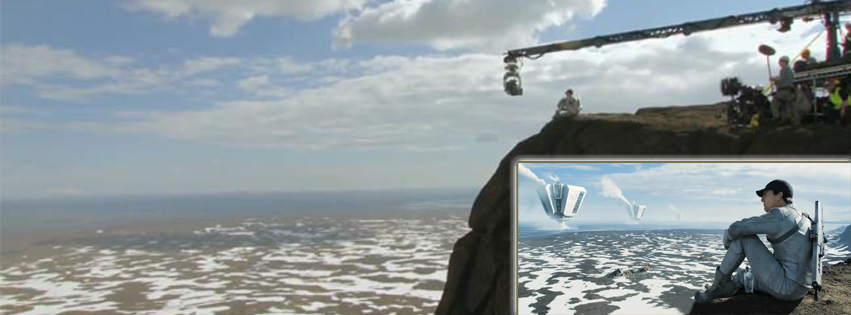
    Oblivion Production Photo

    (Production still – with final insert – from the film Oblivion. This single cliff-top scene took a 60-person crew to shoot. You can’t shoot with 60 people unless you have a plan!)

  • Don’t Give Up Before You Get Good

    I’ve had a rethink about what this blog is about. As much as it’s been my own space to air general thoughts, I actually like the idea of encouraging and equipping people a whole lot more.

    Thus, this post is the first post with this greater level of intent rallying behind it. And it’s something nice and simple to get the ball rolling.

    Last week I was at a media conference on the Gold Coast (Australia), and before one of the keynote sessions they played this video. It encouraged me. And for those of you who are still waiting to be seen (hence the title of the blog, waiting2bscene) – I hope that you may also be encouraged.

  • The Power of Story

    It’s been a while since I wrote, so this one is a whopper. I apologise in advance. 🙂

    I love good media. I really do. There is something extremely satisfying about engaging with media in a way that moves people to action.

    A little while ago my church had a project that needed some video to tell the story. We filmed one of the beautiful mothers in our church sharing some of her story – then I tailed it with a simple After Effects template that was tweaked to give an overall recap of the project. At the conclusion of the clip, the congregation applauded! As linked to previously, I more recently had the opportunity to connect with Hope:Global in the telling of one of their stories which spearheaded a campaign to raise funds for the Village of Hope in Rwanda.

    In both instances, something about the telling of the story engaged with the ‘audience’ and moved them. This got me thinking of a quote often attributed to Plato: “Those who tell the stories rule society.”

    I believe that the power of stories – or myth as Joseph Campbell (author of The Hero with a Thousand Faces) called them – lies in their capacity to communicate and reveal truth. For brevities sake I don’t want to get into the age old question that Pontius Pilate asked of Jesus, “What is truth?” (John 18:38) Suffice to say for now that while different people have differing understandings of truth, the role of storytelling plays a vital role in the conveyance of those truths. A good tale told well will easily communicate ‘truth’ to an audience.

    P.K. McInerney once noted that, “Good reasons for what you believe, should be recognizable as good reasons by other reasonable people.” If that premise is true, then having other reasonable people recognise (and ultimately accept) truths is the great aim of any story. We have even coined a phrase to ask, “What’s the moral of the story?” Subsequently, I would suggest that if Plato’s premise that there is such power inherent in storytelling is correct, then the potential for its abuse is sort of frightening. In fact, that is one of the reasons I seldom watch the news any more. I find it is no longer reporting news inasmuch as it has become a vehicle with which to tell the masses a story of the ‘truths’ of fear, and danger, and hate, and violence, and etc. But it turns out that’s not as new an idea as we’ve been led to believe since ‘9/11’.

    Mass manipulation through fear – and it’s manipulating brother aspiration too, to be honest – is a long-standing abuse by mainstream media. If you wind the clock back to early twentieth century, we can find Edward Bernays telling us that, “The conscious and intelligent manipulation of the organized habits and opinions of the masses is an important element in democratic society. Those who manipulate this unseen mechanism of society constitute an invisible government which is the true ruling power of our country. We are governed, our minds are molded, our tastes formed, our ideas suggested, largely by men we have never heard of…” (Bernays, 1928)

    Seldom do we find the virtuous story that inspires us to action in today’s economy. But those are the stories we need more than ever. Why does a story like Les Misérables continue to fire the imagination with it’s numerous stage shows and cinematic releases? Because it communicates love, forgiveness, redemption, self-sacrifice, and courage – to name but a few of the truths that Victor Hugo explored. These kind of truths resonate and inspire us. Is it any wonder that classical myths were so grandiose in nature? Yes, manipulation through fear and aspiration can get people moving: but they are short term solutions. Only inspiration produces long term results.

    And that is where I come full circle. Even though the vast majority of media enterprise is at best frightfully wasted (can anyone say Big Brother?), or at worst, flagrantly manipulative – I still love good media. I love it for the continued potential it has to inspire humanity to deep, long-lasting truths such as faith, hope, and love. And I love it because both you and I can actually step up, cease to be spectators, and actually become active participants in the media conversation if we want to. And when we do that, maybe our own story will inspire others to action. Now wouldn’t that be a story?

  • A Global Impact for Hope:Global

    When Mark and Darlene Zschech first started their NGO it was called Hope:Rwanda. But let’s face it – there have been more wars, genocides, and other unimaginable atrocities that have affected this world in the last 30-40 years or so than those that happened in Rwanda in 1994. And so what began as Hope:Rwanda transitioned to Hope:Global. And a mere 7-weeks ago, my wife and I had the opportunity to head to Rwanda with the Hope team: Marie in the capacity of an early childhood educator who was helping to train Rwandan nationals. And me in the capacity of the team’s media guy.

    And it is because of this that I felt the need to write something of a back-story to this week’s video link. It’s exciting for me, as some of my footage from this recent trip made the final cut in this Village of Hope promo video that is hitting the globe at the moment! And – even if they hadn’t – I was privileged and blessed to have been a part of the process anyway! The even more exciting news for me though, is that it doesn’t stop there: you can also find out more about Hope through this week’s partnership with a fantastic for-profit company called Sevenly (every week they support a cause, and donate $7 from every product sold that week to their promoted cause… this week, Sevenly is promoting Hope:Global!).

    God has got something big happening here. And I get to sit in one of the box seats as he does! But I digress: that’s enough about me. Check out the video already would ya! 🙂

  • Media Missions

    I understand that there are plenty of people who do not subscribe to a ‘religious’ faith of any sort, and I can certainly understand why people make such decisions. I am not one of those people though. I have had a solid Christian faith for 16 years now. But why is that important to mention as a part of the Waiting2BScene blog? It is important for me, as I have found a number of media opportunities arising through Christian (non-church) ministry groups over the last few months.

    Just a little while ago I happened into the role of sole videographer for the Sydney shoot of an up-and-coming Bible Society Australia youth initiative. Then just four weeks ago I left for Rwanda with the Hope: Global (formerly Hope: Rwanda) Early Childhood and English education team to be the team’s photographer and videographer. Having arrived back in Australia just two weeks ago, I have already had some of my time seconded out to do some video work for the up-and-coming Chaplaincy Australia national conference. And then on top of that, this week I was asked by an acquaintance of mine who lives over in India if I would be able to give him some tips on video production for his own TV presentation back home!

    As a Christian, then, I acknowledge such ‘suddenly’ moments with a kind of wonder, as it is clear to me that God has got something quite different in store for this coming season. And as the namesake of my business concept suggests – God has some manner of missions media stuffs that are just waiting to be seen: and I am just a little excited about the potential impact which may come through this kind of God-work.

  • Music Video Work in Progress (Times 3)

    One of the exciting opportunities I have had over the last 6 months has been working alongside an excellent Australian artist in Jon Reichardt.

    We have been collaborating to bring about music videos for three amazing song covers that Jon performed live in studio here in Sydney (kind of like the Kimbra songs done live at Sing Sing Studios in Melbourne). The audio has been finalised (may I just put this out there: I think that Jon is one of the most amazing live vocalists I have seen perform. He is pretty much pitch perfect, all of the time. It’s unnaturally good!), and we are in the final stages of post-production for the three videos.

    It has been a massive effort producing three music videos at the same time on a less-than-micro-budget… but we’re almost there. And Jon likes the artistic look and feel of them which, at the end of the day, is the important thing. So I am looking forward to revealing this new series of music videos that are just waiting2bscene. 🙂

    UPDATE:

    The clips have been finalised and given the full okay! But Jon is on a bit of a hiatus at the moment, so I’ll have to wait a little bit longer still before doing the big reveal. Such is life… there is plenty of other stuff on the boil at the moment, so all is well with my soul as they say.

  • Small Piece for ‘Generation Fire’

    Earlier this year, we were asked to set up an advert for the Generation Fire National Gathering. Being friends with the Gen Fire co-ordinator, Sash did the work for free. And as such, rather than start the whole process from scratch we utilised an After Effects CS5 template from the amazing crew at Videhive to pull it together, and this was the finished product.

  • A Concept Piece to Inspire Journaling…

    Welcome to the newly developed site (in association with the good folk from WordPress) for Waiting 2B Scene Productions. In this first post, we demonstrate a proof of concept piece (Note: as a proof of concept, we did not aim to present a perfect piece with good audio… just that the concept was valid) that was done in co-operation with the young adult (NSYA) community of North Shore Christian Centre in Chatswood (North Sydney). The idea was to inspire the young adults of the church to journal their Bible reading times. The young adults pastor loved the overall concept, and a series of clips have been slated for production.