Tag: Stanley Kubrick

  • Blog: Employing Symmetry (Part 2)

    Blog: Employing Symmetry (Part 2)

    In part 1, we introduced the idea of engaging with symmetry. The reason for this guide? In the same way that we tend to love patterns, symmetry is like Nutella for our eyes. And if you don’t like Nutella, what’s wrong with you? Seriously… Nutella is great. And peanut butter. Yum. Nutella AND and peanut butter. Om nom nom.

    Anyhoo, I digress.

    Why do we like symmetry so much? No one actually knows. There have been studies that reveal that babies will stare longer at symmetrical pictures than they will at asymmetrical ones. And scientific evidence also suggests that as a species we’re more attracted to symmetrical faces. In short, there is something extremely appealing about symmetry, and we’re drawn to it. So, then, we need to have a really, really good reason to intentionally mess with this particular guide.

    As with most of the visual rules we employ – that is the key. Once we understand how and why it works – and just as importantly, we can make it work ourselves – we can then consider messing with it. Take for example Stanley Kubrick, as he is a great case study for a/symmetrical cinematography:

    In cinema what isn’t shown is almost as important as what is. Take the masterful direction of A Clockwork Orange’s opening scene for example.

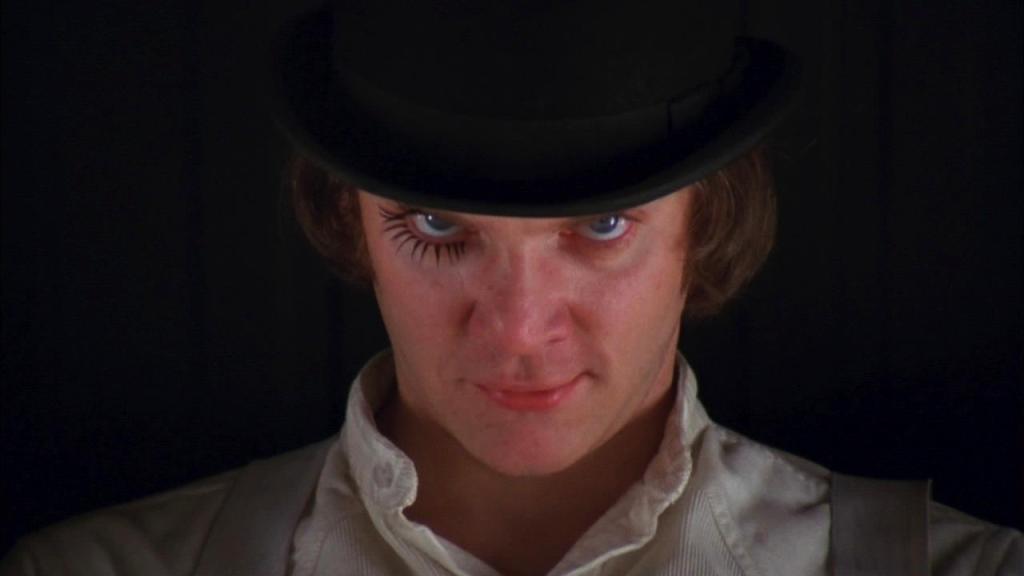
    Kubrik could have started with a wide shot of the Korova Milk Bar. Instead, he begins with a 16-second straight-on tight shot of Alex’s (the protagonist) face in centre frame. Why? In an instant, he highlights a contrast between symmetry and asymmetry to describe Alex’s madness and deviant behaviour.

    Without uttering a word, the viewer immediately perceives the symmetry. But as the 16-seconds lingers, a visual disquiet makes itself known. In addition to being stared at, there was an alteration to the natural balance: Alex has placed black eyelashes on his right eye only. It is only a tiny detail – and yet it is enough for most viewers to be disturbed by this variation, hinting to them that Alex is not normal. This is then emphasised as the long take begins it’s zoom out.

    Let me say this – and I really can’t stress this enough – there should be no rules when it comes to cinema. Techniques such as symmetrical framing (amongst all the rest) will almost ensure that your image will be aesthetically pleasing. But we do run the risk of creating images that are predictable, common, and quite frankly, boring. Nevertheless – we need to know them, know why they work, know how they work, and know why our piece needs to throw that guide right out the window. Even if it’s by using something as simple as eyelashes.

    Do you have your own thoughts and symmetrical suggestions? Leave a comment below. And if you would like to check out another blog post looking at symmetry, the you can gorge yourself right here.
  • Top 25: Most Horrifying Non-Horror Movies

    I have followed Taste of Cinema for a while now, and one of the fun things they do is bring out lists of films of varying genres and such. Most of the time, I’m happy just to enjoy the list and move on. Today’s list has a certain je ne sais quoi about it though: horrifying films that are not horror? What an idea!

    I won’t spoil it for you – but let me at least tease it out by saying that the list includes the likes of Kubrick! 🙂 So here is today’s share: The 25 Most Horrifying Non-Horror Movies in Cinema History.

  • FBF Video: Spielberg vs Hitchcock (ERB) (NSFW)

    Although I have an interest and passion for film and TV, there are some days where I just want to share something that is a bit funny. Today is one of those days, and I want to do a #FBF that merges my passion with some humour. Be warned though, there is a bit of swearing so it may be deemed NSFW.

    Most people have heard of the Epic Rap Battles of History. If you are one of the few that haven’t, you are missing out on some funny stuff! Well in today’s flashback, the ERB team made a battle that pits directorial giants Spielberg and Hitchcock against one another. But it then took a surprising twist! Such fun.

  • Article: “15 Things That Stanley Kubrick Can Teach You About Filmmaking”

    Continuing with my series of resource links – today I want to share with an article which I just finished reading over at the Taste of Cinema entitled, “15 Things That Stanley Kubrick Can Teach You About Filmmaking” (by David Biggins). Below you will find the cliff notes version of the article, but I really encourage you to head over and avail yourself of the full version as soon as you can – it is well worth the read!

    In short form, here are the 15 Things That Stanley Kubrick Can Teach You About Filmmaking:

    1. Match Cuts: “[Not] invented by Kubrick but, so far, no one has ever used it quite as dramatically.”
    2. Using Natural Lighting: “Using the light that would be available to the characters at that moment in time… Kubrick often preferred to light his films in this way.”
    3. Using Artificial Lighting: “The Shining uses both natural and artificial light to help change with the mood changes that occurs during the horror.”
    4. Vanishing Points: “It is perhaps the most easily definable element of a film that makes it recognisably ‘Kubrickian’.”
    5. Tracking Shots: “[Kubrick’s films] feel dynamic because he let his camera flow through the narrative; firstly through tracking…”
    6. Steadicam Shots: “… directors can film a scene in one long continuous take, not having to disturb the actors.”
    7. Hand-held Camerawork: “Picking the right moment to use a hand-held camera can really add drama to a film.”
    8. Long Shot: “A long shot allows you to place a lot of information on screen…”
    9. Wide-angle Lenses in Cramped Spaces: “Many of Kubrick’s films are notable for their use of extreme wide-angle lenses.”
    10. Wide-angle Lenses in Large Spaces: During Paths of Glory’s court martial sequence… Kubrick uses a wide-angle lens so that the sense of depth is maintained but he’s only keeping Private Ferol (Timothy Carey) in focus.”
    11. Zoom Lenses: “[It can be] a beautiful shot that’s uninterrupted by edits, which helps to heighten the tension by keeping the audience member completely in the scene.”
    12. Choice of Film Format: “Kubrick’s productions offer useful examples as to why a filmmaker might have chosen to work with different film formats.”
    13. Chronology: “It’s fairly commonplace to see non-linear narrative films [today]… but it was atypical in 1956… By switching around the order of events, Kubrick dramatically altered how we perceive certain characters on screen.”
    14. Use of Colour: “Kubrick’s true masterstroke is having created a film that uses colour so vividly that it becomes a talking point in itself.”
    15. Casting: “He took this drive for authenticity one step further for Full Metal Jacket when he cast real drill instructor Ronald Lee Ermey…”
    An example of the Kubrickian vanishing point.


    Want to read the unabridged article, you can find it here.