Tag: Manipulation

  • Blog: Employing Symmetry (Part 2)

    Blog: Employing Symmetry (Part 2)

    In part 1, we introduced the idea of engaging with symmetry. The reason for this guide? In the same way that we tend to love patterns, symmetry is like Nutella for our eyes. And if you don’t like Nutella, what’s wrong with you? Seriously… Nutella is great. And peanut butter. Yum. Nutella AND and peanut butter. Om nom nom.

    Anyhoo, I digress.

    Why do we like symmetry so much? No one actually knows. There have been studies that reveal that babies will stare longer at symmetrical pictures than they will at asymmetrical ones. And scientific evidence also suggests that as a species we’re more attracted to symmetrical faces. In short, there is something extremely appealing about symmetry, and we’re drawn to it. So, then, we need to have a really, really good reason to intentionally mess with this particular guide.

    As with most of the visual rules we employ – that is the key. Once we understand how and why it works – and just as importantly, we can make it work ourselves – we can then consider messing with it. Take for example Stanley Kubrick, as he is a great case study for a/symmetrical cinematography:

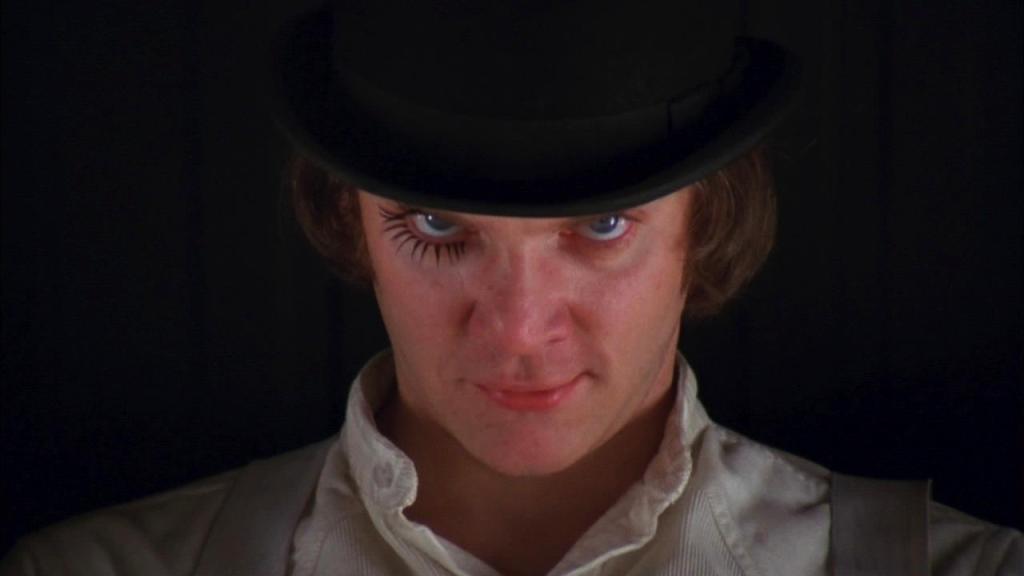
    In cinema what isn’t shown is almost as important as what is. Take the masterful direction of A Clockwork Orange’s opening scene for example.

    Kubrik could have started with a wide shot of the Korova Milk Bar. Instead, he begins with a 16-second straight-on tight shot of Alex’s (the protagonist) face in centre frame. Why? In an instant, he highlights a contrast between symmetry and asymmetry to describe Alex’s madness and deviant behaviour.

    Without uttering a word, the viewer immediately perceives the symmetry. But as the 16-seconds lingers, a visual disquiet makes itself known. In addition to being stared at, there was an alteration to the natural balance: Alex has placed black eyelashes on his right eye only. It is only a tiny detail – and yet it is enough for most viewers to be disturbed by this variation, hinting to them that Alex is not normal. This is then emphasised as the long take begins it’s zoom out.

    Let me say this – and I really can’t stress this enough – there should be no rules when it comes to cinema. Techniques such as symmetrical framing (amongst all the rest) will almost ensure that your image will be aesthetically pleasing. But we do run the risk of creating images that are predictable, common, and quite frankly, boring. Nevertheless – we need to know them, know why they work, know how they work, and know why our piece needs to throw that guide right out the window. Even if it’s by using something as simple as eyelashes.

    Do you have your own thoughts and symmetrical suggestions? Leave a comment below. And if you would like to check out another blog post looking at symmetry, the you can gorge yourself right here.

  • Blog: Employing Symmetry (Part 1)

    If you have ever done research on how to get the right visual shot – whether painted, photographed, or captured in motion – then you probably know the ‘rules.’ This stuff isn’t new. But today I think it’s worth repeating.

    The elephant in the room is that, to misquote the rogue pirate Barbossa, “… the code is more what you’d call “guidelines” than actual rules.” While there is aesthetic appeal with a host of the visual rules that have developed over centuries – the fact is that we can quite easily go ahead and break them. But. Before we do… we really ought to know why the guidelines exist, and why they work first. Then we can decide when and how to best ignore them for our work.

    To demonstrate, take a look at this montage of the cinematographic symmetry (try saying that three times fast!) used in the internationally acclaimed TV series, Sherlock.

    There is something kind of soothing about it, isn’t there? To put it as simply as I can, where the goal of composition is to create a path that is pleasing for the eyes to follow (this is why the guideline exists) – symmetry gives the viewer a vague sense of the harmonious, of beautiful proportions, and of balance (this is why this particular guideline works).

    There are many techniques that will strengthen (or weaken) the symmetric properties of an object or scene. How much of a scene we choose to show is paramount. So too is the position of the camera in relation to the subject, its height, tilt etc. We also need to take particular care to ensure the centre of the composition is equidistant (my word of the day!) to both sides. When done right, it looks simply beautiful. But can you imagine – for example – a shot of the Taj Mahal (an entirely symmetrical structure… right down to its symmetrical reflection in the pools of water around it) that has been misaligned? Well… it would look sort of like this…

    The fact that this image is only slightly out is enough to make it a jarring visual. So while it is possible to break the guidelines of symmetry, if and when we chose to do so, we will really need to go all out. No half measures.

    Coming up in part 2, we will finish looking at how to employ symmetry with another example or two, and some concluding considerations.

  • Video Montage: Keeping The Distance (Between the Frames)

    Last time I shared a video essay and an article that opened up on the whole idea of framing beyond the rule of thirds. Well today I want to continue in that vein with this great little piece by the Between the Frames channel over at Vimeo. As written in the description, “This video explores how director Bennett Miller consistently uses wide shots throughout Foxcatcher to highlight the physical and emotional distance between characters, their situations and how we, the audience relate to them.”

    Honestly, the montage of all of these elements might leave you feeling a little cold: but it is well worth watching and seeing how much an effect celever framing can have.

  • Video Montage: When Shadows Become Characters (Skorkin)

    So today I was doing my usual perusal of Vimeo (come on now – you know that a key component of the twenty-first century creative process is random internet surfing, right?) when I stumbled on this fresh little piece.

    If you are involved in creative video or film of any sort, then you know a little something about lighting. What I love about this piece is that it demonstrates a variety of ways that cinematographers have grabbed that simple (albeit in a profound kind of way) element of videocraft – ie, lighting – and twisted it into a character in it’s own right. I hope you enjoy it too.

  • Video Essay: Rear Window (Michael McLennan)

    Continuing my series of resource links, today I want to share a short clip that was pieced together by one of my friends, Michael McLennan. Michael also happens to be a long-time cinephile who has worked as producer, director of photography, editor, sound designer, music editor, and has also taught across a variety of film disciplines at the Sydney Film School. Recently picked up by the Indiewire team, today’s clip is a simple video essay that demonstrates Hitchcock’s amazing capacity for structural story-telling. In this instance, we find the story engaging with the audience through a carefully constructed repetition of symmetry.

    I personally find that such examples really ought to reinforce the idea that while amateurs point and shoot and think something along the lines of, “I hope this will look good!” – professionals plan and plan and plan, thinking more along the lines of, “How do I want this to look?” If we want to up our game and get our work seen – then we can all continue to learn tricks from the masters of cinema like this. I hope you enjoy.

  • The Power of Story

    It’s been a while since I wrote, so this one is a whopper. I apologise in advance. 🙂

    I love good media. I really do. There is something extremely satisfying about engaging with media in a way that moves people to action.

    A little while ago my church had a project that needed some video to tell the story. We filmed one of the beautiful mothers in our church sharing some of her story – then I tailed it with a simple After Effects template that was tweaked to give an overall recap of the project. At the conclusion of the clip, the congregation applauded! As linked to previously, I more recently had the opportunity to connect with Hope:Global in the telling of one of their stories which spearheaded a campaign to raise funds for the Village of Hope in Rwanda.

    In both instances, something about the telling of the story engaged with the ‘audience’ and moved them. This got me thinking of a quote often attributed to Plato: “Those who tell the stories rule society.”

    I believe that the power of stories – or myth as Joseph Campbell (author of The Hero with a Thousand Faces) called them – lies in their capacity to communicate and reveal truth. For brevities sake I don’t want to get into the age old question that Pontius Pilate asked of Jesus, “What is truth?” (John 18:38) Suffice to say for now that while different people have differing understandings of truth, the role of storytelling plays a vital role in the conveyance of those truths. A good tale told well will easily communicate ‘truth’ to an audience.

    P.K. McInerney once noted that, “Good reasons for what you believe, should be recognizable as good reasons by other reasonable people.” If that premise is true, then having other reasonable people recognise (and ultimately accept) truths is the great aim of any story. We have even coined a phrase to ask, “What’s the moral of the story?” Subsequently, I would suggest that if Plato’s premise that there is such power inherent in storytelling is correct, then the potential for its abuse is sort of frightening. In fact, that is one of the reasons I seldom watch the news any more. I find it is no longer reporting news inasmuch as it has become a vehicle with which to tell the masses a story of the ‘truths’ of fear, and danger, and hate, and violence, and etc. But it turns out that’s not as new an idea as we’ve been led to believe since ‘9/11’.

    Mass manipulation through fear – and it’s manipulating brother aspiration too, to be honest – is a long-standing abuse by mainstream media. If you wind the clock back to early twentieth century, we can find Edward Bernays telling us that, “The conscious and intelligent manipulation of the organized habits and opinions of the masses is an important element in democratic society. Those who manipulate this unseen mechanism of society constitute an invisible government which is the true ruling power of our country. We are governed, our minds are molded, our tastes formed, our ideas suggested, largely by men we have never heard of…” (Bernays, 1928)

    Seldom do we find the virtuous story that inspires us to action in today’s economy. But those are the stories we need more than ever. Why does a story like Les Misérables continue to fire the imagination with it’s numerous stage shows and cinematic releases? Because it communicates love, forgiveness, redemption, self-sacrifice, and courage – to name but a few of the truths that Victor Hugo explored. These kind of truths resonate and inspire us. Is it any wonder that classical myths were so grandiose in nature? Yes, manipulation through fear and aspiration can get people moving: but they are short term solutions. Only inspiration produces long term results.

    And that is where I come full circle. Even though the vast majority of media enterprise is at best frightfully wasted (can anyone say Big Brother?), or at worst, flagrantly manipulative – I still love good media. I love it for the continued potential it has to inspire humanity to deep, long-lasting truths such as faith, hope, and love. And I love it because both you and I can actually step up, cease to be spectators, and actually become active participants in the media conversation if we want to. And when we do that, maybe our own story will inspire others to action. Now wouldn’t that be a story?