Tag: Directing

  • Article: Shoot, Produce, Edit: The Rise of the Pro “Shreditor”

    People love to know their place. Even when a person considers themselves to be unique and counter-cultural, knowing that they are unique and counter-cultural gives them a sense of location in the grand scheme of things.

    That is why I loved reading this article – Shoot, Produce, Edit: The Rise of the Pro “Shreditor” – by the guys at Premium Beats. It actually gives me a named location in the grand scheme of media-making: I am a shreditor. It sounds cool. Almost TMNT’ish.


    I am a Shredder. I mean, a Shreditor.

    How about you? Where do you fit in the media landscape?

  • Video Essay: See What Happens When Scorsese Goes All Quiet

    In our age of twenty-first century cinema, we’re awash with wondrous visual stories and their corresponding soundtracks (though this is no given! Check out our post on how music coming out of the Marvel Cinematic Universe is actually all kind same-same in the sound department).

    It is because of a ubiquitous big-ness of many soundtracks that I would suggest we actually take more notice when a director decides to do things differently. For example, putting in the necessary effort to deftly craft out a film’s sound design with an absence of musical underscoring.

    Cue this amazing little video essay by Every Frame A Painting on the work of Martin Scorsese. Yes, the man is known for his incredible use of music – however, this essay explores his use of silence throughout his 50-years of cinematic experience. So click away, and check out what happens when Scorsese goes all quiet.

  • Blog: Employing Symmetry (Part 2)

    Blog: Employing Symmetry (Part 2)

    In part 1, we introduced the idea of engaging with symmetry. The reason for this guide? In the same way that we tend to love patterns, symmetry is like Nutella for our eyes. And if you don’t like Nutella, what’s wrong with you? Seriously… Nutella is great. And peanut butter. Yum. Nutella AND and peanut butter. Om nom nom.

    Anyhoo, I digress.

    Why do we like symmetry so much? No one actually knows. There have been studies that reveal that babies will stare longer at symmetrical pictures than they will at asymmetrical ones. And scientific evidence also suggests that as a species we’re more attracted to symmetrical faces. In short, there is something extremely appealing about symmetry, and we’re drawn to it. So, then, we need to have a really, really good reason to intentionally mess with this particular guide.

    As with most of the visual rules we employ – that is the key. Once we understand how and why it works – and just as importantly, we can make it work ourselves – we can then consider messing with it. Take for example Stanley Kubrick, as he is a great case study for a/symmetrical cinematography:

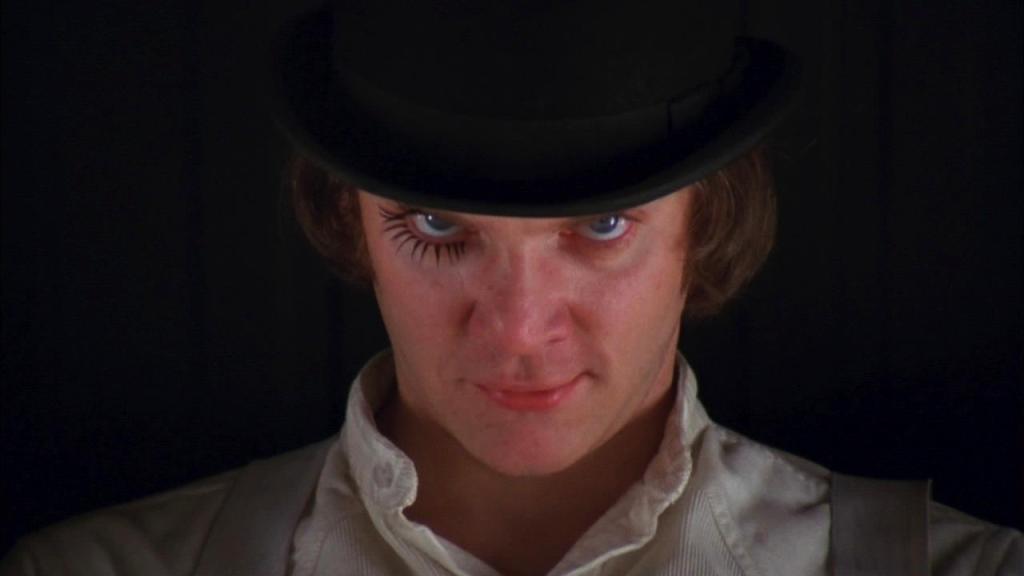
    In cinema what isn’t shown is almost as important as what is. Take the masterful direction of A Clockwork Orange’s opening scene for example.

    Kubrik could have started with a wide shot of the Korova Milk Bar. Instead, he begins with a 16-second straight-on tight shot of Alex’s (the protagonist) face in centre frame. Why? In an instant, he highlights a contrast between symmetry and asymmetry to describe Alex’s madness and deviant behaviour.

    Without uttering a word, the viewer immediately perceives the symmetry. But as the 16-seconds lingers, a visual disquiet makes itself known. In addition to being stared at, there was an alteration to the natural balance: Alex has placed black eyelashes on his right eye only. It is only a tiny detail – and yet it is enough for most viewers to be disturbed by this variation, hinting to them that Alex is not normal. This is then emphasised as the long take begins it’s zoom out.

    Let me say this – and I really can’t stress this enough – there should be no rules when it comes to cinema. Techniques such as symmetrical framing (amongst all the rest) will almost ensure that your image will be aesthetically pleasing. But we do run the risk of creating images that are predictable, common, and quite frankly, boring. Nevertheless – we need to know them, know why they work, know how they work, and know why our piece needs to throw that guide right out the window. Even if it’s by using something as simple as eyelashes.

    Do you have your own thoughts and symmetrical suggestions? Leave a comment below. And if you would like to check out another blog post looking at symmetry, the you can gorge yourself right here.

  • HIMM: A Quiet Long-Take Champion (Zhou)

    A long take – this is simply a shot that doesn’t cut away to other shots, but is a continuous shot that usually follows the action of the scene as it plays out in real-time. Even if you have never heard of the term, I’m sure you have seen one in action (anything that has top-ten style list dedicated to it is probably something which falls into the category of stuff you have seen)!

    In the early years of cinema, it was normal to shoot with long takes – it made production both a little easier, and a bit cheaper. As cinema developed cinematography became more complex, and consequently the pace of editing increased. In what seemed like almost no time, the long take was either done away with altogether, or it directors wielded it as a stylistic badge of honour.

    Let me ask you this then: what if you were able to incorporate the long take into your work without drawing attention to the fact? How would you do it?

    With 55 directorial credits spanning four decades, Steven Spielberg knows how to. The Hollywood giant has used this classic technique so frequently that it is definitely a signature move – yet many of us may not have realised it.

    While other purveyors of the long-take usually parade the shot, Spielberg has managed to have many of his ‘oners’ fly under the radar – allowing audiences to become immersed in the dramatic energy of a scene without noticing the technique being used. Love him or hate him, that is a rare cinematic skill that ought to be celebrated – if not emulated.

    So today on How It’s Made Monday, I want to share an excellent video essay on the Spielberg ‘oner’ by one of my favourite online commentators, Tony Zhou. I hope you enjoy it as much as I did.

    https://vimeo.com/94628727

  • Video Essay: Echoes of Mad Max (WhoIsPablo)

    Australian Director George Miller decided that he did not wish to do a remake or retell the Mad Max story – rather, he wanted to update the universe and the wasteland. He even asked his wife Margaret Sixel to edit the film, even though she had never edited action before. his logic was that, “… if a guy did it, it would look like every other action movie.”

    Even though 2015’s Mad Max: Fury Road is technically an independent movie in the series, it was always a matter of time before someone put in the effort to see whether there were visual echoes between the original Australian New Wave trilogy (1979, 1981, and 1985) and the 2015 release. The good news for fans of the original series is that despite 30-years between drinks, as well as all his intentions to give the world something fresh in Fury Road, a Miller film is a Miller film – and there are echoes in abundance. I hope you enjoy the comparisons as much as I did.

  • Video Essay: Directed By Christopher Nolan (Malko)

    As I wrote recently, I have been reading William Goldman’s book, “Which Lie Did I Tell: More Adventures In The Screen Trade”… a consequence of the reading has been to dull the sheen of the apparent super-powers that directors like Christopher Nolan have always seemed to possess. With that being said – great directors are very much a Ring Master at the Cinema Circus. We all know that there is no show without the talent (everyone from the screen writers, the cinematographers, the sound designers, the actors, and everyone else in between). Likewise, the Cinema Circus must have a Ring Master that can pull it all together and offer the audience as seamless a production as possible.

    Thus today I would like to share a video essay put together by a young Ukrainian videographer, Nikita Malko. Even though it falls into that trap of glorifying Nolan alone amongst his talented crew – it is still a fun little montage.

    https://vimeo.com/134932028

  • Interview: The Directors (The Hollywood Reporter)

    Continuing with my new series of resource links – from video essays, to cinematographer interviews, how-to tips and the like – today I want to do another throwback. This time, I want to take you back three years to an extraordinary round-table style interview with a few of Hollywood’s great directors: Quentin Tarantino, David Russell, Ben Affleck, Ang Lee, Tom Hooper, and Gus Van Sant. Be warned though, it is an hour-long! With that being said, if you are something of a cinephile like me, then let me assure you that it is an hour well spent. Especially when we get insights such as this gem from Tom Hooper:

    “There’s a very curious and complex relationship between time pressure and instinct in that we all hate the time pressure… It’s the hidden narrative of most films. The audience when they’re watching it don’t realise that most of the decisions have been made in relation to time pressure, and that you’re fighting this battle with a ghost that the audience never see. And yet, it’s the time pressure that means that the only thing you can do is work on instinct…”

    Anyway, in terms of film stock – these are a group of better people than me, and they are waiting to spend the next hour with you! So quit wasting time with me, jump on in, and enjoy the rarefied air that these Hollywood directing alumni have on offer!